
By Nicholas Drummond
Part Two provides further perspectives on the future of warfare. It explores tactical elements, including technological innovation and evolving doctrine, which can change radically and often. As before, this is a synthesis of emerging themes resulting from the war in Ukraine.
Part Two – Tactics: Key Trends in Modern Warfare
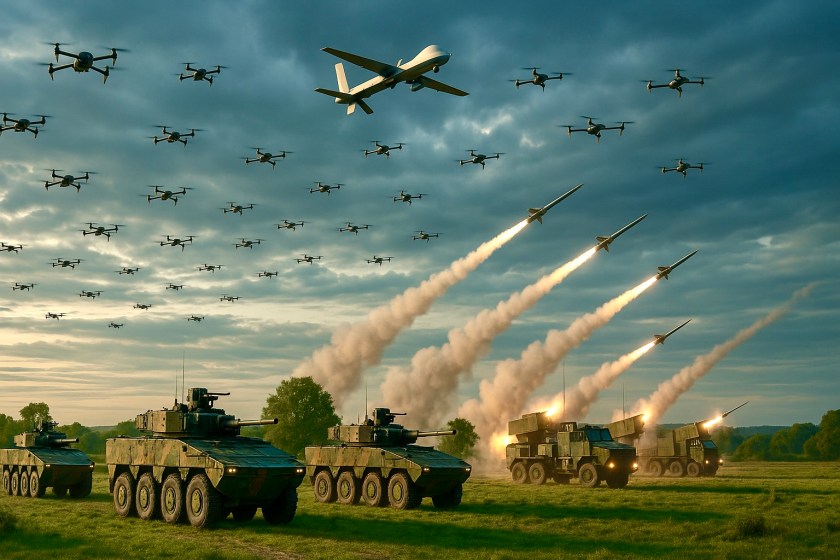
The modern battlefield is undergoing rapid transformation. Technological convergence, especially in drones, sensors, software, and precision fires, is reshaping how military force is applied and resisted. This section identifies and analyses the key tactical trends that are defining 21st-century warfare, from the return of artillery to the rise of autonomous systems, the persistence of infantry to the information advantage. Many of these trends have been starkly illustrated by the fighting in Ukraine – but their implications reach far beyond, pointing to a future of faster, more complex, and more contested combat environments.
The Return of Attritional Warfare
Russia’s full-scale invasion of Ukraine in February 2022 reintroduced Europe to the reality of large-scale, high-intensity, industrial warfare. In contrast to recent expeditionary campaigns like Iraq and Afghanistan, which were characterised by counter-insurgency operations, the war in Ukraine has seen the return of trench warfare, artillery duels, and high casualty rates. It has been described as the most intensive conflict since World War II.
This war has become an attritional stalemate, with both sides are expending vast quantities of ammunition, manpower, and materiel, but without either Russia or Ukraine achieving a decisive impact. While mobility and manoeuvre remain important, victory is likely to be determined by who can endure the longest and replenish their losses fastest. As a result, industrial capacity and logistics are once again central to military success.
Key implications:
- Modern militaries must re-prioritise ammunition stockpiles and production capacity.
- Equipment that is simple, robust, and easy to mass-produce is regaining importance.
- Effective logistical sustainment is a decisive factor in prolonged campaigns.
The Changing Face of the Frontline
The traditional concept of a contiguous frontline has blurred. In Ukraine, the front is dynamic and non-linear. Small units operate semi-independently across dispersed areas. Swarms of drones provide persistent surveillance, denying both sides the ability to mass forces without being detected.
This has led to the emergence of a more fluid battlespace, where tactical actions are often driven by real-time intelligence. Units must constantly move, dig in, camouflage, and displace. Survivability depends on mobility, concealment, and dispersion.
The frontline is now also digital. Cyber operations, electronic warfare, and information operations play a central role in shaping perceptions, disrupting enemy systems, and gaining the initiative.
Key implications:
- Situational awareness and real-time C2 (Command & Control) are mission-critical.
- Units must operate in contested electromagnetic and cyber environments.
- Concealment and deception techniques are once again essential.
Artillery: Still the King of Battle
Artillery has reaffirmed its dominance as the primary killer on the battlefield. In Ukraine, artillery accounts for the majority of casualties. What has changed is how artillery is used. The traditional model of massed fires is being replaced by precise, rapid, digitally-coordinated strikes.
NATO-standard digital fire control systems, like the Advanced Field Artillery Tactical Data System (AFATDS), have proven decisive. Ukraine’s ability to link ISR (Intelligence, Surveillance, Reconnaissance) assets – especially drones – to artillery systems has created a highly responsive kill chain.
A typical engagement now sees a drone detect a target, transmit coordinates via a secure network, and a gun fires within 2-3 minutes – sometimes faster. Western-supplied Excalibur and Bonus rounds have demonstrated extraordinary accuracy.
Russia has adapted too, fielding Lancet loitering munitions and GPS-guided shells. However, Ukraine’s superior digital integration has allowed it to punch above its weight.
Key implications:
- Artillery must be digitally networked, mobile, and supported by persistent ISR.
- Loitering munitions and drones are merging with artillery into a single fires ecosystem.
- Counter-battery radars and drone detection systems are vital for survival.
Drones and Loitering Munitions: A Tactical Revolution
Uncrewed Aerial Systems (UAS) have fundamentally altered battlefield dynamics. From reconnaissance quadcopters to long-range loitering munitions, drones now saturate the battlespace. They are cheap, ubiquitous, and deadly.
Their impact is threefold:
- Persistent ISR – Drones provide commanders with real-time awareness, enabling precise targeting and faster decisions.
- Strike Capability – FPV (First Person View) drones can carry shaped charges or fragmentation warheads, accurately striking tanks, trenches, or supply vehicles.
- Force Multiplication – Drones enable smaller units to operate with greater lethality and autonomy.
Drones have effectively become the new artillery, compressing the sensor-to-shooter loop to seconds. This “panopticon effect” has made traditional concealment nearly impossible.
Russia and Ukraine both operate drone strike units at platoon and company level. Drone pilots are now frontline combatants.
Key implications:
- Every unit must include organic drone teams.
- Anti-drone electronic warfare and jamming are essential defensive tools.
- Drone production and sustainment are strategic capabilities.
Air Defence in the Drone Age
The proliferation of drones has forced a rethinking of air defence. Traditional systems like the Patriot or S-300 are too expensive and too slow to counter swarms of cheap UAS. Instead, layered air defence is required. This includes:
- SHORAD (Short Range Air Defence) using heavy machine guns and cannons with proximity airburst ammunition, MANPADS, and mobile SAMs.
- C-UAS (Counter-UAS) systems including jammers, directed energy weapons (DEWs), and drone interceptors.
- AI-enabled radar and acoustic sensors to detect small UAS at low altitude.
Ukraine’s use of German Gepards and US-supplied Avengers has shown how effective mobile, short-range systems can be.
Looking ahead, DEWs and high-power microwave systems will become crucial for countering swarms.
Key implications:
- Integrated, multi-layered air defence must cover the entire force, not just strategic assets.
- Counter-drone capability is now as important as anti-aircraft or anti-missile systems.
Armour: Survivability in a Transparent Battlespace
Despite multiple obituaries being written for the tank, armoured vehicles remain central to modern land warfare – although their role and survivability are under intense scrutiny. The war in Ukraine has reaffirmed the enduring relevance of Combined Arms Manoeuvre, where tanks, infantry fighting vehicles (IFVs), artillery, engineers, and strike aircraft operate together to seize and hold ground.
The Main Battle Tank (MBT) continues to provide mobile, protected firepower with decisive shock effect, particularly in urban and contested environments. Active Protection Systems (APS) like Trophy and Iron Fist are proving indispensable. Russia has struggled to field equivalent systems at scale. However, there is an urgent need to integrate counter-UAS defences to protect tanks against top attack munitions delivered by drones. Russian tank losses have been heavy. Static armour is a liability. But when used with infantry, electronic protection, and mobile tactics, tanks can still dominate.
The Infantry Fighting Vehicles (IFV), such as M2 Bradley or CV90, have shown their value as highly flexible “infantry motherships,” enabling dismounted troops to close with and defeat the enemy from under armour. The operational mobility of wheeled Infantry Combat Vehicles (ICV) like Stryker has effectively complemented IFVs by being faster and more deployable, though somewhat less protected.
A particular concern is the escalating cost of sophisticated armoured fighting vehicles. At $18–20 million per unit, MBTs have become almost unaffordable, preventing NATO armies from acquiring them in sufficient quantity. Their size, weight, and relative slowness makes them high-priority targets in drone-saturated environments. As a result, there is a growing requirement for inexpensive, protected mobility vehicles that can transport troops. Low cost 4×4 MRAPs at $2 million each are likely to be used more widely, but need better off-road mobility.
The iron triangle has evolved. Firepower, Protection, and Mobility are still relevant to future armoured vehicle design, but Adaptability, Sustainability, and Connectivity, have become additional factors to ensure utility. Trade-offs need to be made based on Complexity, Cognitive burden, and Cost. In the West, hybrid electric drive, AI-enabled targeting, and modular survivability have become key future design requirements,
Key implications:
- Tanks must fight as part of combined arms teams, with drone overwatch and EW support.
- Future armour must prioritise traditional elements of the iron triangle while incorporating new ones; in particular active protection must complement passive protection – and this must be done at a lower unit cost.
- Expect a shift towards lighter, more agile platforms equipped with advanced situational awareness.
Infantry: Still the Final Arbiter of Tactical Success
In an age of precision strike and digital warfare, the infantry soldier remains an irreplaceable component of battlefield success. While artillery and drones can suppress and disrupt enemy positions, only infantry can dislodge and hold ground—especially in complex terrain such as cities, forests, or trench networks. Ukraine has demonstrated that dismounted infantry, supported by mortars, drones, and armour, still dominate the close fight.
While infantry remain the backbone of military operations, their role is evolving. Today’s foot soldier increasingly fights in dispersed teams, supported by drones, data, and long-range fires. Every soldier is a sensor. Helmet cams, battlefield apps, and networked radios allow squads to share targeting data instantly. Urban warfare, trench clearing, and drone hunting are core tasks. The infantry platoon is now part ISR unit, part anti-tank team, part assault force.
The human soldier’s adaptability, tenacity, and moral resilience remain unmatched by machines. As such, while the tools may change, the role of infantry as the “deciders” of ground combat endures.
Key implications:
- Infantry training must emphasise tech integration and decentralised command.
- Every platoon needs drone operators and ISR specialists, adding to the range of equipment that must be carried.
- Reducing the dismounted soldier’s weight burden is critical to reduce fatigue and improve agility on foot.
Logistics Under Fire
It is often said that while artillery wins battles, logistics wins wars. This enduring truth underscores the critical role of sustainment in enabling combat power – especially when operating at distance and under pressure. In Ukraine, Russia’s early failure to secure its logistical lines played a decisive role in derailing its initial military objectives. Convoys stalled, supplies ran short, and manoeuvre forces became immobile—not due to enemy fire alone, but because the sinews of war had snapped. That failure is a cautionary tale, which is why logistical planning and execution have assumed a much greater importance among the key tactical themes of modern conflict.
The character of sustainment has changed. Precision fires, loitering munitions, and persistent ISR have rendered traditional rear-area functions exposed and vulnerable. Logistics is now conducted under fire. In Ukraine, both sides have targeted fuel depots, ammunition dumps, railway junctions, and vehicle convoys, recognising that disrupting sustainment can paralyse frontline operations. HIMARS strikes, Lancet drones, and long-range artillery have all been used to devastating effect against supply nodes well behind the front line. This operational reality has driven a shift to distributed logistics: smaller loads, more convoys, and real-time tracking. Dispersed hubs, hardened storage, mobile resupply, and camouflage are now baseline requirements. Emerging solutions—AI and blockchain to manage inventories and predict demand dynamically, autonomous resupply convoys, pre-positioned materiel caches, and tactical airlift—may help mitigate risk, but none negate the central challenge: in modern warfare, logistics is no longer a secondary function. It is a frontline capability that must be protected, enabled, and fought for like any other element of combat power.
Key implications:
- Logistical solutions must be agile, modular, and resilient.
- Cyber protection of supply networks is a new priority.
- Uncrewed vehicles and AI-managed convoys will become standard.
Information Advantage: 21st Century Warfare’s Killer App
In the digital age, information is not just an enabler of military power – it is a decisive weapon in its own right. Modern warfare has become a data-centric contest, where victory often goes to the side that can see more, decide faster, and act with greater precision. Software-defined Command, Control, Communications, Computers, and Intelligence (C4I) systems now provide real-time situational awareness across all levels of command. AI-assisted systems allow data to be analysed and acted upon so that deployed forces can pre-empt as well as respond rapidly to enemy activities. Faster, better decision-making facilities improved command and control.
Deployed local area networks create an “Internet of Military Things,” linking every sensor to every shooter through resilient, encrypted communications. The networked battlespace allows for the rapid formation of kill chains, where targets detected by drones, satellites, or vehicle sensors can be automatically assigned to appropriate effectors—from artillery batteries to loitering munitions.
At the heart of this capability is algorithmic warfare: the use of artificial intelligence, electronic warfare (EW), and signals intelligence (SIGINT) to automate the detection, identification, and engagement of targets. Warfare increasingly resembles a high-speed contest of hide and seek – whoever finds, fixes, and finishes the enemy first wins. In this environment, information advantage is not merely a support function; it delivers decisive effect.
Russia has used EW and cyber offensively, but Ukraine’s agility and use of Western systems has given it an edge. AI is not just about technology—it’s about culture: decentralised command, trust in junior leaders, and digital literacy.
Key implications:
- Every level of command must understand and exploit information as a weapon.
- AI and data fusion are critical enablers of faster decision-making.
- The fight for cognitive and electronic dominance is ongoing.
CONCLUSION
The future of warfare is not a break from the past, but an acceleration of change in its character. While technological progress continues to deliver new tools, war is still concerned with destroying enemy forces, seizing terrain, and breaking the enemy’s will to fight. Despite the promise of innovative technologies, they seldom deliver a transformational advantage. Depending on unproven systems can be disastrous if they fail.
War in the future will be fought by armies that incorporate a mix of a mix of reliable legacy systems and bleeding-edge tech, because proven systems are still needed to de-risk innovation as it matures. Ultimately, wars will still be fought by human beings to achieve human objectives—and that, above all, is why the more war changes, the more it stays the same.
 UK Land Power