
By Nicholas Drummond
This article is a departure from the blog’s usual focus on land domain topics and looks at the RAF’s future combat air strategy and the difficult choices it will need to make.
Contents
01. Introduction
02. Enter Tempest: A New Approach to Combat Air
03. Could Tempest Be the B-21’s European Cousin?
04. Not enough Typhoons or F-35Bs
05. Managing Strategic Risk: De-Risking Tempest
06. Hard Truths and Difficult Choices
07. Summary Recommendations
01. Introduction
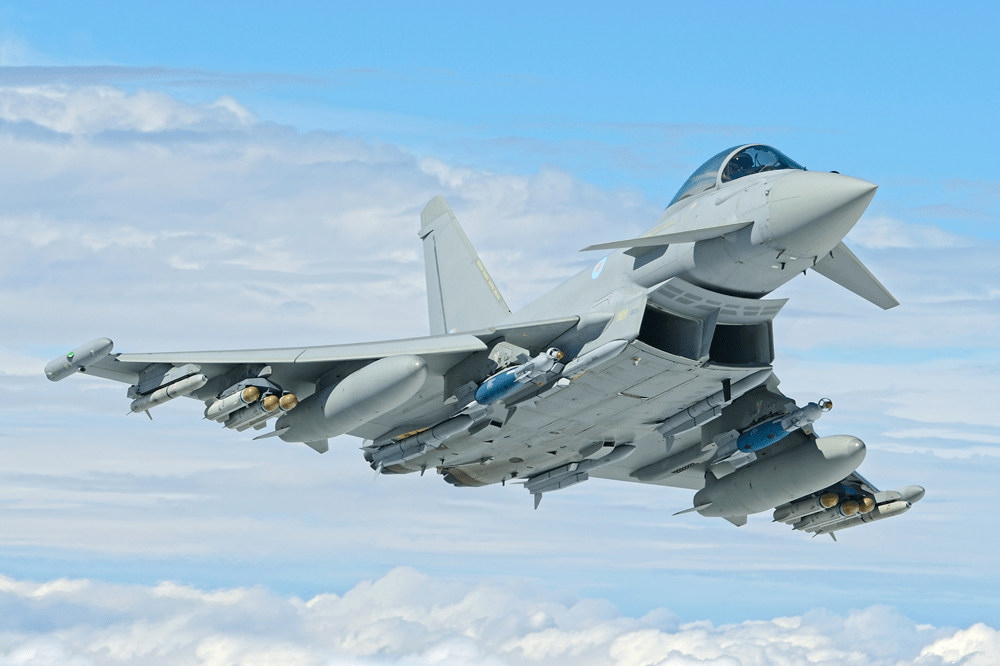
The RAF’s combat aircraft fleet is currently comprised of two types: the Eurofighter Typhoon and the Lockheed-Martin F-35B Lightning II. The Typhoon is a 4th Generation aircraft that first flew in 1994. It has been in service since 2003 and replaced the Panavia Tornado in the air defence role. The F-35 is a newer 5th Generation jet and flew for the first time in 2006. It was intended to replace both Harrier and Tornado in the strike role. The F-35B is measurably superior to the Harrier in range, weapons load, supersonic performance, and stealth, but it was always a stretch to assume it could match the Tornado’s long-legged endurance and sheer grunt as a bomb-truck. To some extent, modifying Typhoon to perform a strike role has compensated for the F-35’s limitations. However, when Typhoon is used as a strike aircraft, it’s diverted from its primary task of air defence—reducing overall mission flexibility. The RAF therefore faces a persistent gap in its ability to deliver long-range strike missions without compromising airspace control. It needs to fill this gap while looking to the future.
02. Enter Tempest: A New Approach to Combat Air
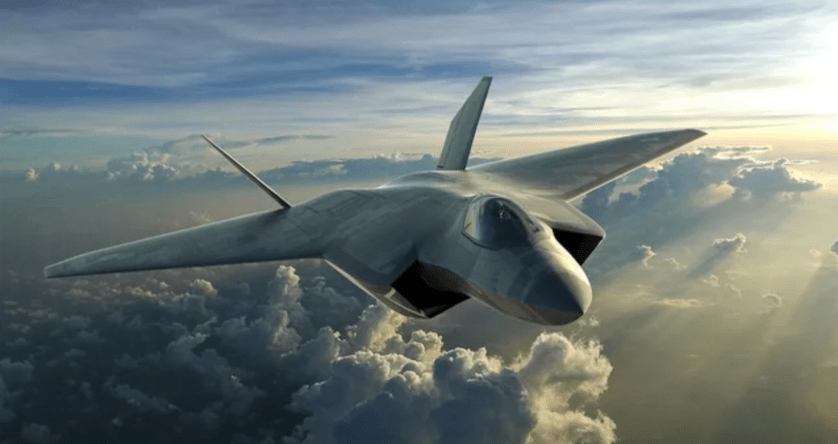
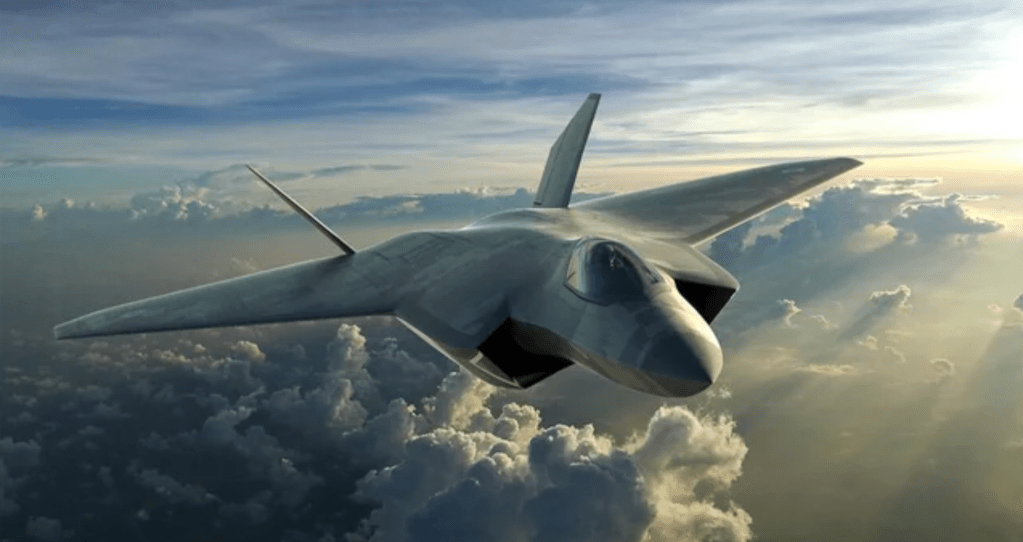
What the RAF really needs is a stealthy long-range strike aircraft that is also a capable air defence fighter. The response to this requirement is the Global Combat Air Programme (GCAP), under which Tempest is being developed. Early details suggest that Tempest will carry twice the payload of the F-35A and be able to cross the Atlantic un-refuelled. These goals explain why it will be a significantly larger aircraft than originally planned.
Tempest has the potential to replace both Typhoon and F-35B. But using Tempest for Carrier Strike would require a separate version to be developed and for the two Queen Elizabeth Class carriers to be converted to a catapult launch system. Given the considerable extra cost of doing this, F-35Bs can be expected to continue in the Carrier Strike role for the foreseeable future.
Tempest will not only exceed the capabilities of the Typhoon and F-35, but also serve as a “combat cloud” controller—managing a new breed of Unmanned Combat Aerial Vehicle (UCAV) or “Loyal Wingman” drone that will fly alongside it. This makes Tempest more than just a fighter; it will be an intelligent, networked platform designed for multi-domain operations. It will be a true 6th Generation capability.
Notwithstanding the many advantages that Tempest aims to offer, the UCAVs it is designed to work with could actually become more important. General Atomics’ YFQ-42 or Boeing’s MQ-28 Ghost Bat are stealthy, multirole, unmanned combat aerial vehicles intended to operate in concert with crewed aircraft. They represent a radically new and integrated approach to air power. Unfettered by the need to accommodate a human pilot, they can be smaller, more agile and less expensive than legacy aircraft. As the AI used to control advanced UCAVs becomes more sophisticated, they will be able to conduct fully autonomous missions without human interference. Drone technology is evolving at such a prodigious rate that leading aviation experts predict that UCAVs will make manned aircraft redundant. While this seems a likely a future outcome, AI decision-making on-the-fly still needs further refinement. So an interim step is manned-unmanned teaming with crewed aircraft controlling un-crewed autonomous systems. Even so, we have to accept that despite Tempest’s potential, there’s a risk it could have a shorter lifespan than anticipated.

05. Could Tempest Be the B-21’s European Cousin?
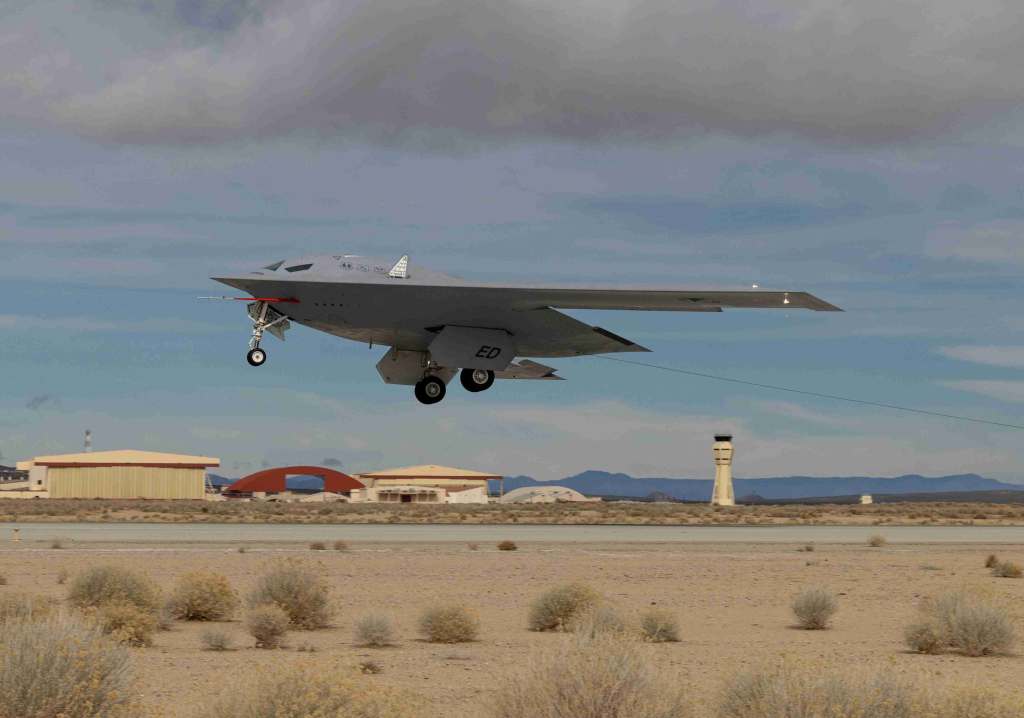
While an optionally manned version of Tempest would offset concerns about its future viability, we should be in no doubt that it’s a step-up from where the RAF is today with Typhoon. Given Tempest’s extended range and payload, a comparison with the US Air Force’s new stealth bomber, the Northrop-Grumman B-21 Raider, is instructive.
The US B-21 Raider is a focused long-range strategic bomber designed for penetrating strike at intercontinental range; but, with an estimated unit cost of $700 million, it sits in a much higher price bracket. In contrast, Tempest is a dual-role fighter and strike aircraft. Tempest cannot match the B-21, but will exceed the endurance and payload of many other strike-fighters. Tempest is expected to cost around $300 million per aircraft, so offers a significant saving versus the B-21, while still delivering significant improvements in range and payload versus legacy aircraft.
This positions Tempest as a uniquely valuable platform—bridging the gap between traditional mid-range strike-fighter and high-end bomber. It won’t drop the same tonnage as a B-21, but its survivability, range, and ability to manage drones will allow it to strike deep into enemy territory with precision and agility. This could make it attractive to other customers looking for a next generation long-range strike capability, especially as the USA is unlikely to permit foreign sales of the B-21. As with Typhoon, Tempest’s success will be linked to its export potential.
03. Not enough Typhoons or F-35B
While the RAF looks forward to its future, its existing combat air fleet has dwindled. The original plan was to acquire 150 Typhoons plus 138 F-35Bs, for a total fleet size of 288 aircraft. But 30 of the older Tranche 1 Typhoons are due to be retired leaving only 107. Meanwhile, only 48 F-35B Lightning II aircraft have so far been confirmed. This means that the total number of RAF fast jets risks falling to 155 in total—an unacceptably low figure for a nation with the sixth largest defence budget and global commitments.
While Typhoon is highly capable, it lacks stealth—a critical factor for modern strike missions. This has created a reluctance to invest further in an aircraft with component technologies that have already been superseded and that will be replaced by Tempest within a decade. Even though Typhoon is a UK-manufactured aircraft, supporting our domestic aerospace industry comes with a huge price tag. The estimated cost per Typhoon is between $125 million to $150 million. At this cost, it has to deliver cutting-edge performance without compromise.
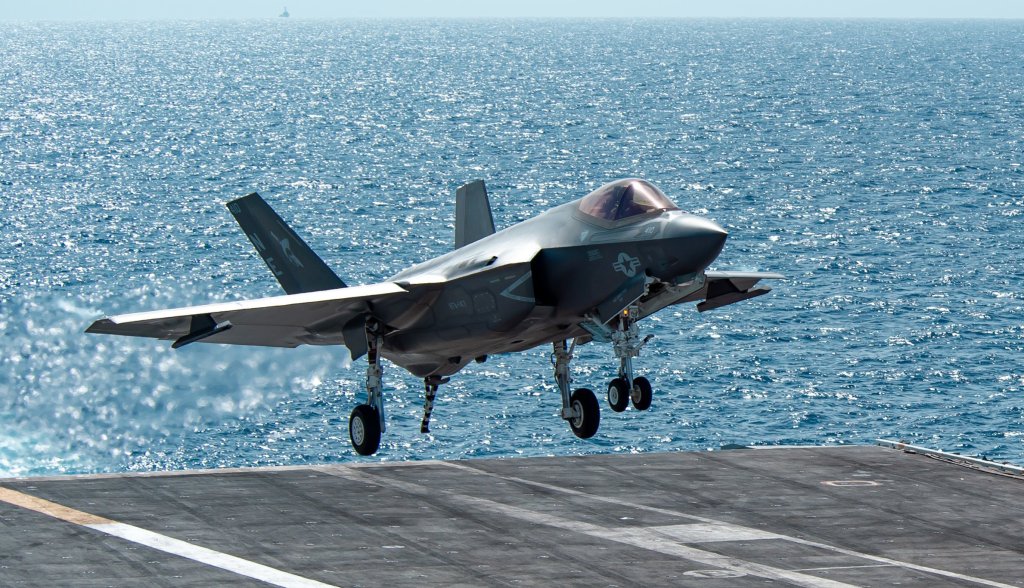
With a per-unit cost of around $110 million, F-35Bs appears to be more affordable compared to Typhoon. However, F-35B through-life support costs have been considerably higher than expected, with ongoing concerns about maintenance complexity. There are also worries about the limitations caused by its Short Take-Off and Vertical Landing (STOVL) configuration—its lift fan reduces un-refuelled range and payload relative to the A and C versions. A further issue is the limited number of weapon types it can carry. So far, only Paveway IV precision guided munitions, Advanced Medium Range Air-to-Air Missiles (AMRAAM), and Advanced Short Range Air-to-Air Missiles (ASRAAM) have been integrated. The RAF is in the process of integrating the Meteor Beyond-Visual-Range Air-to-Air Missile and the Spear 3 Land Attack Cruise Missile.
As with Typhoon, the costs and constraints of the F-35B have created a corresponding reluctance to invest in further numbers beyond those already committed to. However, despite its limitations, the F-35B remains a formidable platform. Its software architecture, sensor fusion, and operational stealth are unmatched in service today. In particular, no other aircraft offers the F-35B’s STOVL capability.
To ensure an adequate budget is available to fund Tempest, we are unlikely to be able to afford more than 24 additional interim aircraft—unless an increase in the defence budget can find the RAF an extra £6 billion. We must therefore choose between a Typhoon fleet of 107+24 aircraft and maintain F-35B numbers at 48. Or accept a reduced Typhoon fleet of 107 and invest in an additional 24 F-35Bs, for a total fleet of 72.
The short-term challenge for the RAF is to increase current aircraft numbers while ensuring it retains sufficient budget to fund Tempest and the Loyal Wingman uncrewed systems that will support it. This is not as straightforward as it seems. Typhoon, F-35 and Tempest all have their supporters and detractors. Choosing the right mix of current and future capabilities demands a healthy dose of realism and trade-offs will need to be made.
With estimates for the US Air Force’s NGAD (F-47) 6th Generation fighter suggesting a unit cost of $300 million per aircraft. It may be foolish to think that Tempest will cost significantly less. Assuming Britain purchases 100 aircraft, it is reasonable to suggest that Tempest will be a £30 billion acquisition. The UK’s armed forces have developed a nasty habit of downplaying programme costs early on, hoping that once politically committed, the Treasury will be forced to continue funding. “Cost-creep blackmail” erodes trust and leads to increased programme scrutiny and delays later.

06. Managing Strategic Risk: De-Risking Tempest
Tempest is being co-developed with Japan and Italy. Like Typhoon before it, international cooperation offers resilience and shared costs. Still, it will be a complex programme with cutting-edge technologies—AI, sensor fusion, adaptive engines—that bring significant delivery risk. Even with a 2035 target, entry into service may not occur until closer to 2040. The question is: what if Tempest is delayed, underperforms, or becomes unaffordable?
Instead of acquiring more Typhoons or F-35Bs, the RAF has proposed the acquisition of the F-35A as a stopgap measure. These cost around $80 million each versus the F-35B, which is around $110 million, and are less costly to operate. The F-35A offers increased payload and range over the B variant, but without its STOVL capability. It could potentially reduce the overall F-35B requirement by performing the same roles more efficiently. The F-35A could also de-risk Tempest in case the latter is delayed or cost prohibitive. However, the extra complexity and cost of supporting a mixed fleet of A and B variants may negate the benefits of the F-35A as there are few synergies between the two versions. Moreover, a reduced number of F-35Bs would clip the wings of the RN’s carrier strike aspirations.
Operational sovereignty is another concern—underscored by the uncertainty created by the Trump administration. There has been much talk of a US kill switch for the F-35. This may have been overstated —if the USA were to prevent an ally using the aircraft it had sold them this would kill US defence exports—however, the risk cannot be discounted.
There are many people who have made a living out of criticising the F-35 programme. While most of them work for competitors of Lockheed-Martin, some of their concerns are justified. The F-35 undoubtedly arrived late. Block 4 software upgrades that will maintain its combat edge still haven’t been delivered and will cost extra. Many desired weapons still haven’t been integrated. The F-35’s stealth coating durability (particularly in maritime environments) is poor. And, as noted above, through-life support for all stealth aircraft is more much complex and expensive than 4th generation aircraft.
In fairness, many of the issues that have emerged reflect the sheer ambition, scale and complexity of the F-35 programme. The billions of dollars spent on developing it have undoubtedly created one of the most capable aircraft in service globally. As refinements such as new engines, new software features, and new coatings are rolled out, the F-35 is undoubtedly maturing into a formidable and reliable aircraft. Perhaps its most important feature is that it has operationalised a vast array of new technologies that will find their way into its successors.
In addition to ongoing refinements to existing versions, Lockheed-Martin has proposed an upgraded aircraft based on the F-35C—the F-35D—which would have larger wings to accommodate an increased fuel and weapons payload, while including many 6th-generation technologies. It promises 80% of NGAD’s functionality with a flyaway price of $150 million, which is half of the F-47’s cost. A new F-35 version seems attractive, but it would still be a Gen 5.5 solution rather than a true next-gen platform like Tempest or F-47. However, with cost being such a critical factor the extra value it offers cannot be dismissed.
07. Hard Truths and Difficult Choices
The RAF is suffering from an acute lack of investment over the last 20 years. With a depleted existing fleet and an expensive future system, it is necessary to consider a range of interim options. Essentially, the RAF needs to procure more F-35Bs and Typhoons now, while investing in Tempest. This will not be cheap—with the added burden of needing to convince the Treasury of the long-term value of regenerating combat air mass. If part of the risk calculus includes a realisation that the UK can no longer rely on the USA as a strategic partner, this will make the UK more reliant on domestically produced aircraft.
However, the RAF cannot expect to be given a blank cheque for Tempest. It must be transparent about the true cost of its development and avoid “scope creep” in requirements. Japan has already requested changes to the GCAP specification, demanding capabilities beyond those originally envisaged. Given that we face threats other than Russia, increased utility and flexibility make sense, but the question is at what point does Tempest become unaffordable?
We may need decide between investing in a homegrown 6th generation aircraft at great cost, or purchasing a non-UK aircraft that delivers the same of better capabilities at a more affordable price. Should we decide not to invest in a British aircraft, the future of our national aerospace industry would be jeopardised. What is not acceptable is to develop a British solution for the sake of national prosperity that is less expensive but less capable than alternatives, because this could result in a white elephant.

08. Summary recommendations
Whatever the RAF does, it must continue to support the development of GCAP / Tempest. It must address the shortfall in total aircraft numbers while providing a pathway to Tempest that de-risks delivery. To achieve these goals, there are four options worth considering:
- The RAF currently has 137 Typhoons, of which 30 are older Tranche 1s that will soon be retired. So the first option is to acquire an additional 24 Typhoons for a total fleet size of 131 aircraft. Typhoon production is still active, and buying more now would keep BAE Systems’ production lines open while waiting for Tempest. Typhoon can probably be delivered the quickest, but is the most expensive, and will become obsolete the soonest. It doesn’t de-risk Tempest. The key question is can Typhoon as a 4th generation aircraft be updated to remain relevant even after Tempest arrives?
- The RAF / Fleet Air Arm currently have 48 F-35Bs on order with the last deliveries to be completed by the end of 2025. According to the Royal Navy, a total of 72 aircraft are needed to make carrier strike viable. So the second option is to increase total F-35B numbers by ordering an additional 24 aircraft. Further F-35Bs will take longer to deliver, are less expensive than Typhoon, and come with increased through-life costs. As a stealth-capable aircraft, F-35B partially de-risks Tempest. Given unexpectedly high fleet sustainment costs, there are those who believe that current numbers should not be increased. The key question is are the carriers viable with only 48 jets?
- The third option is to order 24 additional Typhoons PLUS 24 additional F-35Bs. This is the ideal scenario, but is deemed to be unaffordable as it would reduce the budget needed to fund Tempest. The RAF could split the difference and acquire 12 additional aircraft of each type. The only way to acquire more than 24 aircraft now is if the defence budget can be increased to provide the extra £6 billion in funding that would be needed to purchase 48 aircraft. It may be better to retain as much budget as possible to ensure Tempest’s success.
- If only 24 aircraft are affordable, the RAF has suggested a fourth option: acquiring the F-35A. This would give it increased capabilities versus the F-35B at a lower cost, while de-risking Tempest. The F-35A can be delivered faster than the F-35B and is the least expensive to buy. But it adds a third aircraft type with associated extra support costs and increased complexity. The crucial question here is does F-35A offer a sufficient step-up versus the F-35B to justify the switch?
Choosing between the above options will depend on three factors: flyaway / through-life support costs, how quickly it can be delivered; and the extent to which it de-risks Tempest. What makes the decision so hard is that Typhoon and F-35B have complimentary advantages and disadvantages. If Carrier Strike is paramount and balanced fleets with equal numbers of each aircraft type are preferred, this tips the decision in favour of more F-35Bs—especially as 48 is vastly below the original fleet requirement of 138. If strategic independence, local manufacture, and incremental improvements are prioritised, then Typhoon is the way to go.
In case Tempest is delayed, investing in an incremental improvement strategy for existing aircraft types could be an alternative strategy. This could include rolling out the new European Common Radar System (ECRS) Mk 2 radar more widely across the Typhoon fleet, or developing fixes that would make UK F-35B’s easier and less expensive to operate.
Ultimately, investing in Tempest supports the future of the UK’s aerospace industry. The adage GO BIG OR GO HOME holds true, so the GCAP programme must have sufficient resources allocated to it. Tempest represents an exciting vision for future of British air power—long-range, lethal, and survivable, with unmanned teaming and cross-domain agility. But it would be foolish if it became an “all-of-our-eggs-in-one-basket” gamble. If Tempest proves not to be viable, the RAF will need a contingency plan. This must include the possibility of acquiring a non-British produced aircraft such as the US NGAD (F-47) or F-35D.
The same scenario played out almost exactly 60 years ago when the UK developed the TSR2 long-range reconnaissance-strike aircraft to replace obsolete legacy aircraft. Like Tempest, TSR2 incorporated a variety of leading-edge technologies. Early tests showed that it had significant promise, but in trying to go it alone, this over-ambitious aircraft became a victim of its own complexity. By the time it was deemed unaffordable and was cancelled, it had consumed too much of the available budget to fund what would have been an excellent alternative, the General Dynamics F-111. This time, we have partners with whom costs can be shared, but even so, the RAF must be realistic in its aspirations so that it delivers an affordable future combat air capability.

 UK Land Power