
By Nicholas Drummond
This article considers the merits of the British Army generating two war fighting divisions rather than the single division planned hitherto. The key driver for a revised structure is new multi-domain warfare doctrine and the way in which it evolves how we expect to fight in the future.

Although it has not yet been published, the British Army’s revised “Future Soldier” strategy plans to adopt a two division model. 1st (UK) Division will be a light division with two light mechanised brigades (7th and 11th) plus 16th Air Assault Brigade, while 3rd (UK) Division will be a heavy division with two armoured brigades (12th and 20th) plus 1st Deep Reconnaissance Strike brigade. This is definitely a step in the right direction, but is not yet an ideal structure. What the revised structure effectively delivers at this stage is an expeditionary division that can respond quickly while having a reduced logistical footprint, plus a manoeuvre division that can bring decisive combat power while being more resilient. The expeditionary division is ideal to fight the First Battle / Deep Battle while the manoeuvre division is suited to fighting the Second Battle / Close Battle.
These two concepts have become extremely important within the evolution of multi-domain warfare doctrine. The First Battle / Deep Battle concept is recognition of the fact that, where a defending force can move quickly to prevent territory from being lost, an aggressor will need to have a numerically superior force (ideally 3-to-1) to succeed. Fighting the First Battle / Deep Battle involves pre-emptive deployment to establish a fixed defensive line and a separate mobile forward screen. The latter allows deep fires assets such as rocket artillery and longe-range precision guided weapons to be directed at an attacking force at stand-off distances, engaging enemy units at ranges beyond their ability to return fire. The forward screen will shield artillery assets and canalise the enemy into kill zones while allowing friendly forces to withdraw and regroup as often as possible rather than fighting from fixed positions where they will be subjected to the full weight of enemy artillery. Of course, a fixed line of defences will also be needed, but the mix of static and mobile forces allows the defender to do more with less while sustaining fewer casualties. This approach was well tested in 2022, during the early stages of the Russo-Ukraine conflict. Ukrainian units in light vehicles with anti-armour weapons and ample UAVs were able to deploy rapidly to create forward screens. Though they used ATGMs like Javelin extensively, it was their ability to direct punitive artillery concentrations that blunted the Russian advance so significantly and despite their own units not having heavy armour. Other light infantry units moved rapidly to establish a fixed line of defence by digging trenches with overhead protection. The attacking Russian force was vastly depleted by the time it reached this line and was not able to breach it. A key part of reducing own casualties was using UAVs to direct counter-battery fire at Russian artillery units. The experience of Ukrainian forces has built confidence in the British Army’s light mechanised infantry brigade construct. Currently, these brigades are equipped with Foxhound and Jackal vehicles. Wheeled vehicles provide good operational mobility, but tend to have less than ideal tactical mobility.
In any future conflict scenario, friendly forces will be surprised or outnumbered. It is very likely that we will lose ground that needs to be re-taken. Therefore, we must retain a capacity to fight the Second Battle / Close Battle. This requires us to retain a credible number of main battle tanks, infantry fighting vehicles, and, crucially, manoeuvre support elements, to conduct combined arms manoeuvre. These units can obviously fight the First Battle / Deep Battle effectively, but being primarily tracked, they are less agile and responsive than all-wheeled light mechanised units. Supported by tube and rocket artillery, strike aircraft, attack helicopters, and UAVs, combined arms units will plough their way through an enemy position. This type of head-on approach is the most visceral, brutal and costly type of land warfare, but very often it is unavoidable. Again in Ukraine, the importance of being able to do this was amply demonstrated by Russian forces, which did not begin to make significant territorial gains in 2022 until they resorted to proper combined arms manoeuvre tactics. In particular, the destructive effect of massed artillery fire was pivotal in allowing tanks and infantry fighting vehicles to seize and hold ground. Conversely, in 2023, it was Ukraine’s lack of heavy armour and air power that turned the much anticipated counter-offensive into a damp squib. This experience demonstrates that the British Army is right to retain a manoeuvre element with its 3rd (UK) Division constructed along the lines of a traditional heavy armour force. Tracked vehicles provide good tactical mobility, but lack operational mobility.
Conceptually, the future structure of the British Army makes sense. The two force types complement each other. Expeditionary forces deploy quickly but have less combat power and resilience. Manoeuvre forces have more combat power and resilience, but take longer to deploy. Both light mechanised brigades and armoured brigades should be able to effectively partner with our NATO allies, particularly the US Army. The problem is that the planned equipment types and their distribution within the UK’s two division structure is sub-optimal. This means that combat brigades lack the focus and credibility they need to perform the core range of tasks expected of them. Therefore, this article considers how to invest the two divisions with the resources they need to be credible yet affordable.
The following diagram shows how a two division army might be structured.

The high level aspiration is to create tow capable war fighting divisions with all the enablers needed for them to operate independently, or as part of a coalition force. Each division would have three (or potentially four) combat brigades. The Manoeuvre Division would look something like this.

The Expeditionary Division would adopt an almost identical structure. In both cases, the two divisions would each have 20,000 soldiers, or 40,000 in a total. An Army of 73,000 ought to be able to generate two credible divisions.

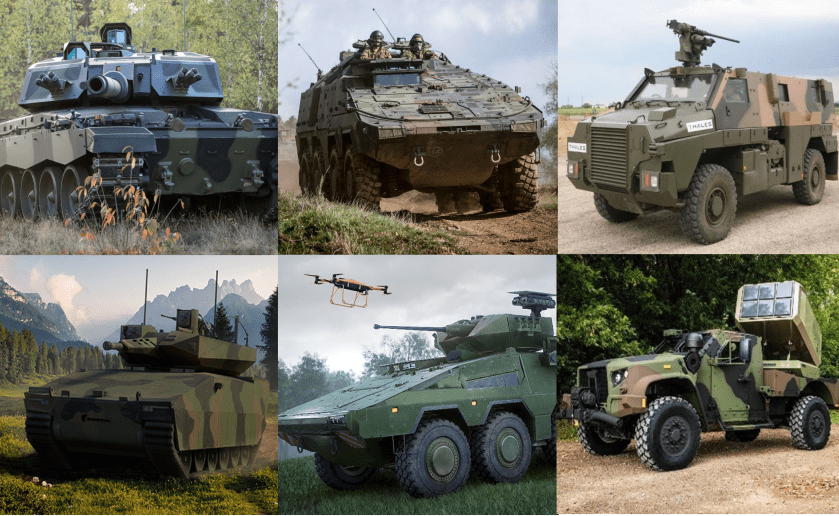
Relatively little extra investment is needed to achieve the above structure, because the British Army’s modernisation plans have already been well conceived to reflect new and emerging doctrine. Also, they encompass equipment purchases that will deliver much of the capability uplift needed. In particular, and in common with our allies, the British Army is being rebuilt around six core vehicle types:
- Heavy Tracked – The Challenger 3 upgrade programme will deliver a worthwhile life extension to the fleet; however, the increased weight of the platform without a proper automotive upgrade to provide a bump in power creates extra programme risk. Our experience with the failed Warrior CSP shows the dangers of mounting a new turret on an old chassis. The other problem is that we will only upgrade 148 out of previous fleet of 227 Challenger 2s. To acquire an increased number, we would need to manufacture new Challenger hulls. As soon as we do this, Challenger 3 will become a new MBT programme with vastly increased costs, risk and an extended delivery timeline. Unfortunately, we need a minimum of 200 MBTs to equip four armoured regiments plus a training squadron. Without this, partnering with a US ABCT will be problematic. The other serious oversight with the LEP is that it will not upgrade CRAAV (repair and recovery), Titan (bridgelayer) and Trojan (engineer) vehicles. These are essential if we are to clear a path through enemy defences and obstacles.
- Medium Tracked – The Ajax programme aims to deliver a family of 589 reconnaissance vehicles on a new medium tracked chassis. There is no need to re-state that this is a troubled programme, apart from pointing out that it isn’t yet clear when the capability will be delivered. At this point, the Army needs a Plan B in case Ajax comes later than advertised or not at all. The other elephant in the room with Ajax is its size and signature. Ukraine has shown that reconnaissance vehicles operating forward without infantry support are vulnerable. Increasingly, drones are being used for reconnaissance. Where vehicles are needed, there s a tendency to use much smaller stealthier platforms. In addition to Ajax, the UK operates a second vehicle in this category, the Warrior IFV. This platform was expected to be upgraded, but was cancelled after the programme ran into difficulties that extended the delivery timeline and doubled the final cost. Warrior is expected to be retired from 2027 and there are no plans to replace it. Within the Army, there are those who believe that the need for a new IFV is more pressing than the need for a reconnaissance vehicle family. The failure hitherto to deliver a vehicle within this category is what most impacts the British Army’s future force credibility.
- Medium Wheeled – The Boxer MIV programme is underway and will deliver 623 multi-role armoured vehicles. Although it is late due to supply chain constraints resulting from the pandemic, it will provide mechanised infantry battalions with a much needed capability. Unlike most other wheeled platforms, Boxer combines good operational mobility with very high levels of tactical mobility; but it’s an APC more than an IFV. As such it is intended to deliver dismounted infantry to wherever they are needed. Boxer can operate with Challenger 3 just as the FV432 APC used to be battle grouped with Chieftain, but Boxer is not intended to operate within the direct fire zone because it lacks a turret and protection. Adding armour to Boxer is possible, but compromises its mobility. Ultimately, Boxer will become an entire family of vehicles that will include infantry carriers, command and control, specialist carriers, ambulance, mortar, bridgelayer, repair and recovery, air defence, counter-battery radar, anti-armour, engineer, artillery platform, and, potentially, an assault gun.
- Light Wheeled (Medium Protected Mobility) – This is one of three classes of vehicle within the Land Mobility Programme (LMP). The Medium PM requirement reflects the need to acquire a less expensive troop carrying vehicle for light mechanised infantry. This type of vehicle will additionally be used for command and control, ISTAR, GBAD, CBRN, ambulance, tactical support, and other battlefield roles. Medium PM vehicles will replace Mastiff, Ridgeback and Wolfhound, as well as Stormer and FV432 Bulldog. Something like the Thales Bushmaster, KNDS Dingo, GDLS Dingo, or Patria AWV will be acquired.
- Light Wheeled (Light Protected Mobility) – This class of vehicle is needed to supplement and eventually replace Foxhound and HMT platforms. The Light PM category will be used for command and liaison, command and control, patrol tasks, ISTAR, GBAD, CBRN, tactical support and utility roles. Light PM vehicle options include the Oshkosh JLTV, Thales Hawkei, and KNDS AMPV.
- Light Wheeled (Light Mobility) – This class of vehicles will replace the venerable Land-Rover Defender in the general support / utility role. It will also include a lightly armoured version. Light utility vehicles will be supplemented by a further light tactical mobility platform, such as the Polaris MRZR for use by air assault and special forces.
This overall fleet concept is extremely sound and will give the British Army the utility it needs across multiple war fighting scenarios. It will also streamline the overall number of platform types operated, reducing support costs. The major modification that the plan needs is greater adaption towards high end war fighting against near-peer adversaries. But what does this mean? Within the British Army’s overall headcount cap of 73,000 personnel, the Army’s 2030 plan (released in 2021) envisaged eight brigades as follows:
- 12th Armoured Brigade
- 20th Armoured Brigade
- 1st Deep Reconnaissance Strike Brigade
- 7th Light Mechanised Brigade
- 4th Light Brigade
- 16th Air Assault Brigade
- 11th Security Force Assistance Brigade
- Army Special Operations Brigade (Ranger Regiment)
It has been discussed elsewhere how this structure lacks focus and relevance. The most serious compromise is combining Boxer and Challenger 3 in the two armoured brigades. Challenger cannot keep pace with Boxer when deploying long distances by road. Boxer lacks the protection to follow closely behind Challenger 3 in combined arms assaults. The Deep Reconnaissance Strike Brigade lacks organic infantry and will be a paper formation until Ajax is fully delivered. 4th Light Brigade lacks any kind of protected mobility. It is not clear what role 11th SFA Brigade will play now that the Ranger Regiment has been raised to perform similar tasks. This brigade seems rooted in the last conflict, not the next one. While the Ranger Regiment has shown that it can perform useful Tier 2 SF, training, and mentoring roles, it still disguises the fact that we have too few proper infantry battalions. Therefore, I propose a simple modification to the structure:
- 12th Armoured Brigade becomes a traditional heavy armour brigade with CR3 and a new IFV
- 20th Armoured Brigade becomes a traditional heavy armour brigade with CR3 and a new IFV
- 7th Light Mechanised Brigade becomes a medium brigade with Boxer
- 4th Light Brigade becomes a medium brigade with Boxer
- 16th Air Assault Brigade remains unchanged
- 11th SFA Brigade becomes 11th Light Mechanised Brigade
- 1st Deep Reconnaissance Strike Brigade becomes an artillery brigade as before, and a second light mechanised brigade is generate from the remaining infantry battalions
- The Army Special Operations Brigade remains unchanged.
This revision is based on the existing headcount cap. It delivers 31 total infantry battalions, or 27 full-strength battalions instead of the current 23. The result is two heavy armour brigades, two medium Boxer brigades, two light mechanised brigades, an air assault brigade, and a ranger brigade.
To deliver this structure, 12th and 20th Armoured Brigades need additional Challenger 3 MBTs plus a new IFV as noted above. I make no recommendation as to what this should be. Assuming Ajax issues can be resolved completely, using a turreted Ares variant would suffice. Alternatively, we should select whatever XM30 option the US Army chooses for its OMFV requirement, A third option is CV90, which is thoroughly capable and proven. Whatever IFV option is adopted, we would generate four armoured infantry battalions supported by four type 44 tank regiments to create two square armoured brigades. This would enable infantry battalions and armoured regiments to be battle grouped together.
4th and 7th Medium Brigades would be equipped with Boxer. Instead of grouping them with Ajax reconnaissance regiments, I would re-designate the four RAC regiments destined to receive Ajax as Medium Cavalry regiments and equip them with a Boxer “Dragoon” variant. This vehicle would essentially be a UAS mothership designed to perform six roles in support of the four infantry battalions:
- Reconnaissance and surveillance using UAS
- Artillery fire control
- Direct fire support for infantry
- Counter UAS
- Defeating enemy armour at longer ranges
- Flank and rear area protection
As with the armoured brigades, having four infantry battalions and four cavalry regiments, allows the different unit types to be battle grouped together. You would not want to single units to have a mix of standard infantry carrier vehicles and turreted vehicles, because giving the infantry additional tasks dilutes the number of boots on the ground and thus their effectiveness in their core dismounted role.
The Boxer Dragoon or cavalry vehicle would be equipped with a remote control turret mounting a 30×173 mm cannon plus twin ATGMs. The anti-tank missile could be Javelin, MMP Akeron or Spike LR, but Brimstone or a loitering munition like Switchblade 600 or Hero 400EC, would also be useful. The vehicle would have excellent sensors and be able to launch and recover military grade quadcopters with a 50-70 km range. I envisage a crew of five: driver, gunner, commander, and two UAS operators.
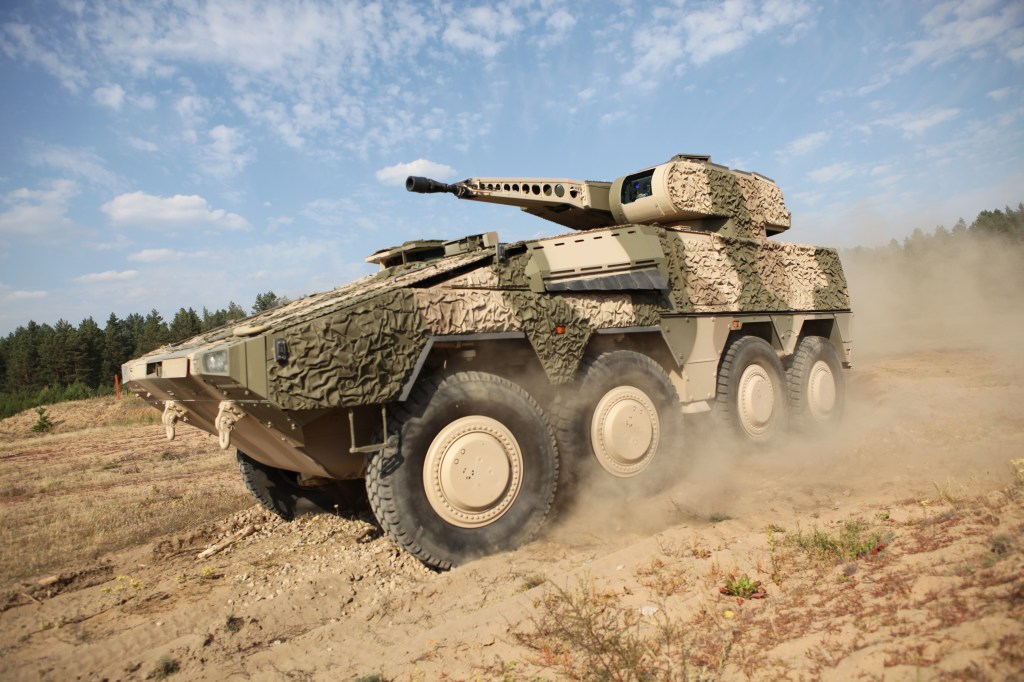
It might make sense to have separate cannon equipped vehicles and UAS carriers. Some degree of experimentation is needed to identify the exact type and mix of vehicles. One option would be to equip each troop with four Boxer Dragoon vehicles plus four JLTV-type 4×4 Light PM vehicles. The latter could be used for stealthy reconnaissance tasks and would mount a remote weapon station plus ATGM.
For both Heavy and Medium brigades, manoeuvre support vehicles would be essential. Consequently, it would be necessary to upgrade CRAAV, Titan and Trojan, or to find an alternative. Similarly, the medium brigades would need a Boxer repair and recovery vehicle, a Boxer bridgelayer, and a Boxer Engineer vehicle. Fortunately, these additional variants are already planned. For the Light brigades, acquiring vehicles like Bushmaster / Hawkei or Dingo / JLTV would be suitable.
Each frontline combat brigade needs organic combat support (CS) and combat service support (CSS) enablers. At present, we have sufficient, artillery, engineer, signals, logistics, REME, and medical units to support only five brigades. Any increase in headcount would be used to generate more of these, which were lost in 2010.
So far, extra investment has been directed at manoeuvre units and logistical support. However, recent experience in Ukraine underlines the ongoing relevance and potency of artillery. It has accounted for the largest numbers of casualties on both sides. The UK is presently conducting a modernisation programme to upgrade its M270 G/ MLRS launchers to the A2 standard, as well as the Mobile Fires Platform programme to acquire a 52-calibre 155 mm self-propelled howitzer. An unanswered question is how does the Army replace the 105 mm light gun? One school of thought advocates 120 mm mortars. These can now hit targets at 12-13 kilometres instead of 9 kilometres thanks to improved munition. A mix or turreted and towed 120 mm mortar systems would be lethal but also highly deployable. Another view is to acquire more 155 mm guns, but the logistics of 155 mm ammunition favours something smaller for expeditionary warfare. My own view is that a mix of 155 mm howitzers and 120 mm mortars would suffice.
The Royal Artillery currently has 12 regular regiments, but probably needs 14 to 16. Of the total, it requires at least four field regiments with 155 mm guns, plus the same number of G/MLRS regiments. To ensure rocket artillery regiments can support medium and light infantry when deployed in an expeditionary capacity, there is a case to acquire a wheeled MLRS system like HIMARS. The RA needs an STA regiment and UAV regiment, plus a short-range air defence (SHORAD) regiment and a medium range air defence (MRAD) regiment with around 96 and 48 launchers respectively.
Hitherto, UAS have been a Royal Artillery asset; however, the Ukraine conflict has seen attritable and affordable drones used extensively across all unit types. Used for surveillance and strike, the British Army needs to issue them much more widely, even at section and detachment level. First-Person View (FPV) drones overlap with loitering munitions and provide novel targeting opportunities. In a very real sense, low cost UAS have democratised air power by making it more affordable, more immediate, and more efficient.
The final missing piece of the Army’s modernisation puzzle is C4I. It was originally planned to upgrade the current Bowman system by moving it from a closed to an open architecture standard as part of the Morpheus / LEtacCIS programme. Called EVO, this work stream was cancelled in late 2023 after GDMS failed to deliver what had been agreed. If the Army is to replace Bowman before it comes obsolete, it will need to purchase a system off the shelf. Fortunately, there are several reliable options to choose from, so the cancellation of EVO may be a blessing in disguise.
The biggest barrier to any uplift in the Army’s overall utility is the lack of personnel. At the moment, frontline units are wholly dependent on the Army Reserve to deploy. This is sub-optimal because reserve troops never spend a decent amount of time training with the units to which they would be attached. This reduces the overall effectiveness of those units. Equally important, using the Army Reserve to backfill an under-strength Regular Army prevents it from carry out its primary functions. These are:
- To provide battlefield casualty replacements
- To provide specialist personnel
- To generate a second echelon force
- To drive the expansion of the Army as a whole
Based on the current and proposed force structures, the ideal peacetime size of the Regular Army is around 90,000 to 100,000 soldiers, plus an Army Reserve of 20,000 to 30,000.
Funding these changes would need an estimated one-off increase in the Army’s equipment budget of around £10 billion, plus an additional £5 billion per annum in running costs. The two most significant extra costs would be additional personnel and equipment support. Increasing the Defence budget to 2.5% of GDP could achieve the revised force structure within 5 years.
In summary, I have tried to articulate a revised force that would be more credible and usable than what we have today, but without breaking the bank. The viability of this proposal can be assessed by comparing it to the challenge faced by the US Army in the aftermath of the Vietnam War. As the Cold War threat grew through the 1970s and 1980s, America needed to regenerate its Army at a time when morale was at an all-time low. This was achieved by improving its career offer, education, and the acquisition of new equipment. The arrival of the M1 Abrams MBT, Bradley M2 IFV, and AH-64 Apache attack helicopter enabled the US Army to achieve a dramatic turnaround in recruitment, the restoration of morale, and a renewed a sense of purpose. This is what the British Army needs today.
 UK Land Power
Another shopping list and request for money when most other government departments are having budget cuts.
Recruiting is low due to the demographic that traditionally makes up the majority of recruits are being told they are not wanted and the groups the military are hoping will take up the slack believe the country is bigoted, racist and misogynistic. So I’m not sure your extra personal is even achievable with the funding.
Could I make a suggestion of lowering recruiting standards to help with the personnel short fall? Maybe lower the vetting requirements for entering the British military, would that help?
“A few billion is all that’s required to truly transform the army” I hear the cry. Sounds strangely like the cry made for FRES or all manner of other programmes, shame the track record of wasting billions and delivering sweet FA is what the military is known for, I’m sure you’ll persuade the public.
Perhaps the military could point out their Stella victories in Iraq and Afghanistan to the public as an example of the capability the investment would get them.
Too much has been wasted, lost and gapped to start thinking a turn around is on the cards.
The army will continue to talk divisions while it struggles to generate a brigade that can truly fight a manoeuvre war.
LikeLiked by 1 person
A great read, a clear and rationale structure.
Questions:
LikeLike
To address your questions, there are five high-level points to emphasise:
LikeLiked by 2 people
Thanks ND. A post about the wider NATO requirement would be really interesting. Would it be a corps on the finnish front (Fin, Sweden, Norway), a corps on the Baltic front Estonia, Latvia, Lithuania), a corps on the polish front (Poland, Germany, US), and another on the Romanian front (Bulgaria, Romania, Hungry, Italy). So four corps, two army groups split at Kaliningrad?
LikeLiked by 1 person
This model only works if everyone agrees to not shoot at the first division the UK deploys. Because if this first division takes significant casualties they will be replaced by people from the second division, leaving it incomplete to replace the first division. Pretending that the British Army can currently deploy above brigade Level, or ever will be able to for the foreseeable future is just wishful thinking.
LikeLiked by 2 people
An excellently and well constructed article setting out logical progressive operational thinking as we have come to expect from Nicholas Drummond. My two points are;
When will we see such authoritatively researched, argued and written papers emanating from within Westminster, Whitehall and the Myriad Military and Political bodies employed to safeguard our nation.
What impact will the eventual demise of fossil fuel for military vehicles have upon future planning, vehicle acquisition and logistics? Surely this must start to be included in planning and future development of forces.
CJH
LikeLiked by 1 person
“I would re-designate the four RAC regiments destined to receive Ajax as Medium Cavalry regiments and equip them with a Boxer “Dragoon” variant”.
So what happens to the already purchased Ajax vehicles?
LikeLike
Good question. I try to answer it in the article. The core issue is that a very large question mark still hangs over Ajax and its delivery timeline. The Army has spent £4.8 billion out of the total budget of £5.5 billion, according to Government figures, but only 150 vehicles have been manufactured to date. GDLS is likely to need an extra £2+ billion to deliver all 589, although I may be wrong. Even if Ajax’s problems are now behind it, how long will it take to produce and deliver the outstanding number of vehicles?
Given the uncertainty and risk still attached to the Ajax programme, I think we have reached a point where we need a back-up solution. That is why I have proposed a Boxer Cavalry vehicle. I have much greater confidence that this can be delivered according to a fixed price and timeline. If Ajax is subsequently fixed, then the Ares version can replace Warrior by fitting a remote turret. You take out the equipment racks on one side and you can seat an additional three dismounts. Total crew would be 3 +6. Potentially, each 3 Div brigade could have 1 x Challenger 3 regiment, 1 x Ajax regiment and 2 x Ares battalions. That would work. Not ideal but better than no Warrior.
LikeLiked by 1 person
I follow your logic, but I believe there are only 93 Ares on order – probably not enough to equip the 2 battalions?
My solution would be offer all 589 Ajax variants to Ukraine instead of the £2.5 billion of other kit we’d be sending them per year for the next 2-3 years. Then spend that £2.5 billion per year on Boxer Dragoon and other much needed kit for the UK Armed Forces.
LikeLike
Great article,
LikeLiked by 1 person
I have corrected the diagram for the Manoeuvre Division. It now has 4 armoured regiments and 4 IFV battalions. Overall, the two divisions have an almost identical structure. They differ only in the types of vehicle operated.
The SHORAD air defence regiment would have four batteries of 24 launchers or 96 in total (which is what we originally had with Stormer / HVM). That’s enough for one battery per brigade. For MRAD, you would each have four batteries with 12 launch sets each, or 48 in total. Effectively, you’d have four SHORAD regiments and two MRAD regiments. Regardless, your point is valid, we must ensure decent GBAD coverage.
LikeLiked by 1 person
Nice to see you back Nick!
Great thought provoking article, and there is much I agree with, especially the split into 2 Div’s, however I really cannot get onboard with the dogma of the “first/deep” and “second/close” battle, which I personally find intellectually lazy.
Let us put your two Divisions, basically 3 Div “heavy and tracked” and 1 Div “medium and wheeled” into UK Geo-Political and military strategic context:
3 Div is really servicing our “Euro NATO” commitment, which is focused on leading the NATO Enhanced Forward Presence Battle Group (EFP BG) in Estonia and; 1 Div is the “rest of the world” force, the “expeditionary” force, which can also be used within continental Europe, committed to NATO in the event of Russian aggression.
3 Div’s Mechanised BG(s) in Estonia are not fighting a “first deep” battle, with reinforcements fighting a “second close” battle, they would be fighting all of them, simultaneously and alongside Estonian army and territorial defence, and other NATO allies who contribute the EFP BG’s. The “first battle” in this case is going to be both a defensive close battle, to prevent loss of Estonian territory, but also trading space for time where necessary in a highly dynamic defence. At the same time GMLRS / GMLRS-ER and air power will be taking the “deep” battle to Russian AD, C2 and logistics units, basically following Cold War doctrine of “Follow On Forces Attack” (FOFA being the NATO doctrine derived from US “Air-Land” battle). So being able to manoeuvre aggressively to prevent ground being lost, is not a role for rapidly deployed medium to light forces, which don’t have the logistics necessary to support the weight of fires required, and realistically will never bring anything heavier than host nation, or host nation based allied forces will already have in place. Therefore 3 Div and it’s Brigades needs to be structured appropriately to be constantly rotating forces through Estonia deployments while maintaining quality of life and working within harmony guidelines. Say each Bde (2 Mech, 1 Mech Inf) has 4 Sqdns or Companies on a 1 in 4 cycle, with 9 months in every 3 years being spent in Estonia. With NATO’s policy to increase EFP forces from BG to Brigade size, each of 3 Div’s Brigades would have an all-arms Company/Sqdn BG in place, plus the contributions from allies that currently include France and Denmark. An extra Sqdn / Companies worth of kit should be stored in Estonia, as it will be easier and faster to surge troops to that kit in time of crises. If tensions turn hot and Russia attacks the Baltics, or Finland, or both, you now ideally have a British Forces Estonia made up of 6 Sqdn / Company size BG’s, 4 with MBT and IFV (e.g 4 x 14 = 56 Chally 3) and 2 with Mech Infantry to hold their rear / logistics “bastion” plus M270 MLRS, 155mm tube artillery and Land Ceptre (CAMM) AD. Is that enough, probably not but maybe good enough in an allied context. Meanwhile the second echelon force is the 2 Sqdns / Companies of each Brigade that were in training and maintenance in the UK. How do you get them to the battle in Estonia is a bigger question of multi-domain operations and whether the US-Polish forces are holding the Suwalki gap, whether NATO has decided to flatten Kaliningrad etc.
All the above, to say that if we are being realistic the focus of 3 Div has to be EFP Estonia, the modern equivalent of BAOR.
1 Div forces self deployed on their wheels across Europe to Poland or Bulgaria or wherever are going to be reinforcements to local host nation and allied forces, or if somehow they get to an area before Russia attacks it, they can die bravely taking out many BMP’s with Javelins but they won’t have the weight of logistics with them, at least initially, if ever, to fight the deep battle. So let’s not pretend that they will ever be anything but a deep operational reserve, working with host nation or allied heavy forces as and where required. In that context, equip them appropriately for the role, they may be the exploitation force behind allied heavy armour for a penetrating counter attack, or they may form the backbone of an urban defensive operation, but they won’t be working alone. However they might well be working alone, or with considerably less support in their “global expeditionary” role, in Africa perhaps.
In summary, let’s focus on a hard as nails heavy tracked armour and supporting elements in Estonia, and the Boxer based expeditionary force and cut our cloth accordingly.
LikeLiked by 2 people
Great article, and also the comments. Thank you.
We know what we need to contribute to a credible conventional deterrent in Europe and it is an Army Corps of at least three divisions, located on mainland Europe. We have done it before and it worked.
Poland is buying 1250 tanks, probably more.
But the political will is simply not there, British defence spending 6% of GDP during the 1950s, Health spending 3.6%. Health spending is now 7.5%, defence spending 2.5% (not really).
Probably something radical might help.
The entire British Armed Forces currently number about the same as the U.S. Marine Corps (USMC). The USMC has ships and twice as many aircraft as the Royal Air Force.
Consider the savings to be made by reorganising (delayering) Britain’s armed forces to resemble the USMC? Why not use the same equipment, neatly making our problematic procurement system entirely redundant?
Otherwise brilliant articles like this will come and go but nothing much will ever happen until Poland is invaded……deja vu all over again.
LikeLike
I have taken some extracts relating to personnel.
1. The [two division] structure would require two additional artillery regiments … Also one additional RAC regiment… Additional units would be created by diverting headcount from other areas. This would see HQ units reduced in size.
2. In both cases, the two divisions would each have 20,000 soldiers, or 40,000 in a total. An Army of 73,000 ought to be able to generate two credible divisions.
3. At present, we have sufficient, artillery, engineer, signals, logistics, REME, and medical units to support only five brigades. Any increase in headcount would be used to generate more of these.
4. At the moment, frontline units are wholly dependent on the Army Reserve to deploy.
5. Based on the current and proposed force structures, the ideal peacetime size of the Regular Army is around 90,000 to 100,000 soldiers, plus an Army Reserve of 20,000 to 30,000.
An Army of 73,000 trade trained, plus thousands more in training, ought to be able to generate two divisions each with 20,000 as in Extract 2. This could include diverting headcount as in Extract 1. So why does Extract 5 say around another 20,000 are needed? Is a division of 20,000 regulars wholly dependent on the Army reserve, as in Extract 4, and the deployed strength will be higher? Does the division of 20,000 only include the present support for 5 brigades, as in Extract 3?
LikeLike
You can generate the structure I have proposed from the existing headcount cap and it works. To resource the additional units recommended, I would eliminate the ARRC HQ unit as this ties up 4,000 personnel. So If you want to generate the extra units proposed without reducing HQs in size, or redistributing personnel from elsewhere, then you need an extra 4,000 soldiers, or 77,000 in total.
Even with 77,000 soldiers, the revised structure would still depend on the Army Reserve to actually deploy boots on the ground. I don’t like this. As I have already said, if you rely on the Army Reserve to backfill the Regular Army, then the Army Reserve cannot focus on its core tasks, which is to provide a second / third echelon force and to drive the wider expansion of the Army.
If you want to deploy the Regular Army without relying on the Army Reserve, then you need to increase it in size to around 90K.
LikeLike
Thanks Nicholas
So with reserves, a deployed division will be larger than 20,000. I am not bothered by how much, just that a division needs those reserve units.
I am also not bothered about keeping ARRC HQ. But I think your 4,000 personnel includes 104 Theatre Sustainment Brigade and 1st Signal Brigade. There are units in there I do think need to be kept, eg 17 Port & Maritime Regiment.
LikeLike
A deployed division will have around 20,000 personnel including reserves. In addition to the two core divisions the Army has, it also has Filed Army Troops. These are essentially Corps assets that support them. The ARRC HQ is quite manpower intensive. Some view the ARRC as a vanity project. We need to focus on combat power. We also need the Army to be less top heavy.
LikeLike
See my Extract 2 above. You say an Army of 73,000 ought to be able to generate two credible divisions. If the credible deployed divisions are 20,000 including reserves then they are not generated from an Army of 73,000. They are generated from a larger Army including reserves.
On the subject off ARRC, BAR186 has an article specifically on ARRC and other articles that mention it.
LikeLike
The problem is lack of money and repeatedly any ability to spend it on things that are needed. We have projects that fail or stretch out for decades, – from Nimrod AEW onward. Costly inadequate PFIs producing large, often now unused, buildings, few pilots and few recruits. . We are developing a fighter for Bae to sell Saudis, in 2035, when currently Europe could be a smoking ruin by 2026 , and munitions stocks , and combat capabilty , are horribly lacking. It all just shows a complete lack of appreciation of the dangers, and the Treasurys focus on cuts, spreadsheets and the City.
And theres managing to sustain the world’s smallest ready nuclear force whilst spending a large proportion of the defence budget – , albeit belatedly , on its production infrastructure , All while producing a deterrent that’s now more vital than ever in a Trump and Putin universe, but is less strategically capable than those powers with a full nuclear triad – like Israel , Pakistan, N Korea , India , and France or pre 1990s Britain..
In there somewhere are Secretaries of State and PMs who change regularly, and with few exceptions , know so little they cant ask the right questions, or follow up a policy even if they do understand it.
The expeditionary division is a dubious beast. It preserves infantry units and more senior officers. It can get to European crises faster. But in modern jeeps it will die even faster. Theres a reason why Ukrainian TDF brigades have acquired some tanks, Lithuania is aiming for half as many tank units as we are, and Poland 10 times as many. And as for ground based air defence it’s difficult to find anyone but Portugal and some of the smaller states in Europe with less than the UK .Our home bases are less well defended than those in Greece, Romania, Sweden, Poland and Finland., And any fool who suggests yet another return to colonial war fighting , a la Afghanistan or Iraq , should be sacked on the spot. You lose all those wars because you dont have the will, persistence, resources or ruthlessness to succeed. Let’s not bother losing again.
Two divisions would be great if we could actually arm them, and some troops to replace losses in one division would seem necessary. But a serious response to Putin requires at least 3 armoured brigades, one propositioned, and one forward deployed. Plus the new tech seen in Ukraine .
If we cant do that, the better if long term plan might be to focus more on a larger RAF - where we wouldnt have fewer fighters than Italy France or Greece , and less than half as many as Israel, and wouldnt be using Typhoons to cover for 150 missing strike aircraft and try and defend UK and NATO airspace at once. We dont want to fight the Russian hordes on the groundvin WW1 or WW2 style . We need to destroy them en masse, and destroy their lines of communication, firepower , air support and supplies
Ideally we need a lot more F35s , and we need to put a theatre nuclear capability on them. The big problem is we would be way down the order list and the RAF and PFI have fouled up recruiting , and combat training takes a long time.,,, , We should at the least be doing what Italy Germany and Spain are and adding new Typhoons to replace tranche 1, not actally reducing the fewest ever few by just scrapping our tranche ones and making do with even fewer. And we might, like the US Air National Guard have a better mechanism to recall retiring pilots, and deploy fewer pilots to desks – at least until the world looks safer. If ex military air line pilots on alert were good enough to launch on 911 to save DC, one in a tranche 1 Typhoon should be able to shoot down the incoming Bear it was made for.
The navy is simpler, it – needs a few more ships , some more SSNs if we can squeeze them in to the production schedule and aircraft to fill the carrier hangers not have a 66000 carrier for ever pretending to be HMS invincible. Some sailors and pilots to man them would be good too such is the defence depths Governments since 1990 have taken us too.
Too expensive you say, but France manages almost all of that, Italy manages to have most of that. And small countries like Finland do better pro rata. We just spend but get too little for it. …and if we never start to fill the gaps things will just get worse.
LikeLike
Government departments, including MoD, spend over what HMG collects in taxes. The treasury fills the gap with loans focussing, as you say, on the city. When political dogma like PFI is thrown in, the treasury still comes up with the money. I don’t now how they do it. Let’s applaud the geniuses.
At the opposite end of the scale, MoD money is not spent well and you point out several countries do better. If I went into that it could become a rant. It should be a small change that the army, in particular, work with what the army has ordered. 148 CR3 and 146 Boxer infantry carriers. How do they fit into brigades or divisions? If the army can’t work with their order there is no justification for more.
LikeLike
Really good to see a new post after a very long time! You are probably the only blogger out there who is interested in serious things, like logistics, organization, tactics, etc 🙂
So in this regards, I am curious about your opinion on mixing different types of vehicles together. You seem (and as far as I remember always have) to be clearly against it.
On the other hand, General Skrzypczak, who used to be a commander of our Land Forces, wrote a few years ago a somewhat famous analysis which was strongly promoting platform unification. (I am attaching a link to an English version).
https://pulaski.pl/en/analysis-proposed-changes-the-land-forces-battalions/
But recently he came out and admitted that he was wrong and that his opinions changed after observing the conflict in Ukraine and now he is against battalions based on uniform platforms. Most importantly he is open to mixing tracked and wheeled vehicles at the battalion level. He wrote two papers about it but unfortunately they have not been translated into English.
It would be great to see you interview him, or have a discussion with him, about this aspect.
LikeLiked by 1 person
I might have misread your article but I notice that your manoeuvre division doesn’t appear to have any formation reconnaissance units either at brigade or divisional level. Is there any reason for this?
LikeLike
Yet another first-rate article, well conceived, planned an expressed. First-rate!
I just wanted to start with one question. I don’t know whether it was a figment of my imagination or whether I actually read it but was it not the case that several months ago, the military scribes were discussing the possibility of an accompanying vehicle for the planned new Infantry Fighting Vehicle . It would be rather a “Value” version of the more sophisticated IFV, without all the expensive add-ons. It would , in fact, be rather like the old FV432, compared to the Warrior.. Now, I might very well have missed it, but I don’t think you made any reference in your article. Has the concept been quietly dropped then, perhaps to save money? 0r is it still integral to the concept of the future British Army? Surely we need something like it. After all, Marks and Sparks sells “value”versions of its food lines! I have several more questions lined up!
LikeLike
At the moment, the British Army has no plans to replace Warrior with a new IFV. The IFV role will be fulfilled by Boxer. Hopefully, a turreted version will follow in due course. It will field a Medium Protected Mobility vehicle for light mechanised infantry. This will be something like Bushmaster, Dingo, Eagle or a similar 4×4 MRAP. This will very much be a budget APC. Meanwhile, the US Army has the M2 Bradley which will be replaced by the XM30 / OMFV in due course. It has also recently introduced the AMPV, which is a value version of the M2 Bradley without a turret, and this will replace the aged M113.
LikeLike
I was,. a few years ago now, talking to some Royal Marines down at Plymouth. They seemed very interested by the question I asked about the relative merits of the 105mm Light Gun and the 120 mm Mortar. The Dutch Marines were at the time, I think, using the 120 mortar in their reconnaissance units. There were the usual comments about calibres and “bigger bang for your buck” etc. over the mortar. I know that it can sort out reverse slopes very effectivel bu are there any other advantages?
LikeLike
The 105 mm gun has a longer range and a lesser safe distance, allowing assaulting troops to get closer to an enemy position before fire has to be lifted. But new 120 mm mortar ammunition natures now reach 13-15 kilometres (versus the 105 mm gun’s 17 kilometres) while having a larger, and more circular burst radius because rounds descend at a much steeper angle. My personal believe is that all field regiments should have 155 mm while we should use G/MLRS systems more wifely, both M270A2 and HIMARS. Give Armoured and Mechanised Infantry a turreted 120 mm system and light infantry either towed 120 mm, and I think you have an optimised solution. For 7 RHA (the artillery regiment that supports 16 Air Assault Brigade) the obvious replacement for the 105 mm gun is HIMARS. The UK is contemplating a 127 mm gun. I just don’t see the value. Stick with 155 mm for all tube artillery.
LikeLike
155 even if a GOAT like the lighter version of CEASAR is logistically challenging to a light unit compared to 105. The lighter types of vehicles that can be gun tractors and ammo haulers for 105’s also makes them attractive for reserve units, which I believe you would like to see built back up too? The problem is we have not kept up. The US has developed a pre-fragmented 105mm round with the now usual suspect for enhanced frag – thousands of tungsten balls. Meanwhile Denel has had a 57 caliber 105mm experimental light gun for nearly 2 decades, that riches out to 26km with its “normal” round, and 30km with a base bleed round. Combine the US shell with the South African gun tech, and 105 leap frogs 120mm mortars, at least in range capabilities. Of course idea,y we would have both……
LikeLike
if we have 2 divisions then what level of commitment is realistically sustainable? Surely we would be better having 4 light and 4 heavy brigades, to be able to deploy 1 of each indefinitely and an additional 1 for surge capacity.
Also if dispersal is a useful defense against modern sensors and precision munitions, then why don’t the brigades have more organic enabling units? Recon, air defense etc. And following this logic shouldn’t we equip battalions or even companies with the full range of capabilities?
I feel we should forget about divisions. We won’t be able to deploy a division in a timely manner, and if it means deploying half our force then our leaders would rightly be reluctant to use this capability.
ultimately we need to keep in mind the bigger picture of NATO, and our geography as an island nation on the west of Europe. I agree we need capable ground forces, of both heavy and light/medium types to support NATO and our own expeditionary needs, but realistically we should have 200 f35, 200 Euro fighters and maybe even another 200 4th gen fighters as missile carriers. Get the carriers working properly and add a few more destroyers/frigates. Maybe a new class of cheap VLS carriers.
As a final point, as much as we all like to think about the kit itself, we should be refocused on the industry. 200 challengers is meaningless if there is no new production. We should have a fixed amount of each equipment type produced each year, with the capacity to seriously multiply in a time of need.
final final point, if all the western countries are rearming, from a small number of companies, then we need to combine orders to get economies of scale. The alternative is we start a bidding war. This is our weakness at play, a lack of centralisation. Let’s hope we can resolve it rather than suffer for it
LikeLike
A division is the smallest unit of an Army Group that deploys with all the assets it needs to be self-sustaining in combat (e.g., force support engineers, force level logistics, and field hospitals), In reality, we are unlikely to ever deploy more than a single division at a time. So, either the expeditionary division or the manoeuvre division would be fielded. It could well be a hybrid division with a structure that reflects the mission at hand. What a second division really gives you is a second echelon force. The first division is likely to need to be rotated out of the line within 3-6 months. So having a second division allows you to remain combat effective for 12 months. This time period buys negotiating time before using WMD or would help facilitate the wider expansion of the Army. What my proposal tries to do is to devise a structure that delivers increased combat power within the existing headcount or marginally increased headcount. Inevitably, compromises will be needed. Ultimately, the correct peacetime size of the Army is 90-100K, but I don’t see it growing back to the 2010 level before 2030.
LikeLike
“The other serious oversight with the LEP is that it will not upgrade CRAAV (repair and recovery), Titan (bridgelayer) and Trojan (engineer).” That is certainly true of two of them, Nick, but please don’t say that the Titan Bridgelayer is not going to be upgraded after all. It seems only a few weeks since I read about Stockport-based company KNDS UK (Krauss-Maffei Wegmann and Nexter) being chosen to deliver the general support bridges based on their Dry Support Bridge design. It will replace the BR90 ABLE system. That was followed a short time later by the news that the close support bridge under ProjectTyro was to go ahead with the fitting of Leguan bridges to Titan. (Unless I imagined the whole thing!). Has this now been quietly cancelled? You are much nearer to British Army news than I am, Nick. Can you please help?
LikeLike
KNDS UK (WFEL) will indeed deliver DSB to replace BR90 ABLE and will also offer the Boxer bridgelayer with a 14 metre Leguan bridge able to support 50 tonnes. The UK will not be fitting Leguan to Titan. Titan is knackered. If it wants a tracked Leguan bridgelayer cable of supporting 100 tonnes, it would need to acquire Leopard 2 Leguan.
LikeLike
A very informative, well balanced piece from Nicholas as usual. I can’t really add any thing here of much significance, as I feel that he has hit the nail on head, with what is required to form the proposed ideal British Army Two Divisional structure discussed in detail. The four key points highlighted here, regard mainly to existing specific platform capability gaps; areas of capability for investment, the headcount of operationally available trained regular personnel and reserves and how they can be distributed amongst the two divisions. Finally, there is a highlighted current lack of critical mass, which will be required to sustain the persistence necessary for a protracted conflict, that underpins this analysis throughout.
A significant degree of concern highlighted in this analysis is in the lack of stockpiles of munitions; stores and spare parts and the logistical support system both at strategic and tactical level. This concern also extends to various gaps in critical battlefield enablers including combat engineering and manoeuvre support, maintenance, ISTAR, electronic warfare and C2. With regards to fulfilling arguably the most glaring equipment capability gap mentioned, I have long held the belief that the retiring of Worrier without a tracked IFV replacement was an ill thought out and short sighted mistake. As has been pointed out, mixing wheeled Boxer with Challenger 3, in the heavy armoured brigade structure is largely incompatible, due to Challenger 3’s primary mission being the second close battle in the direct fire zone. Boxer is ultimately not designed for this, as apposed to a theatre entry standard configured tracked IFV, which is.
Expanding on the highlighted lack of Artillery fire support within the proposed divisional structure, both the Medium Weight Expeditionary Division and Heavy Manoeuvre Division Structures seem to have all of their respective Artillery assets placed into single dedicated Artillery brigades. Therefore, if I am not mistaken, all Artillery Fire Support has been placed at Divisional Command level in both instances. I can’t help thinking, that it might be more advantageous to each of the divisions, to give all of the brigades an attached Artillery Regiment to guarantee organic fire support at brigade command level.
Whilst given the Army is currently in the process of renewing its artillery platforms, I feel the choice of a Self-Propelled 120mm Automatic Mortar System utilising the latest in Smart and Guided 120mm Mortar Munitions, would provide the Indirect Close Fire Support required of both the Medium Weight Expeditionary and Light Role Infantry battalions within their relevant brigade structures. To fulfill this capability and taking into consideration, the limited Army headcount, I think the NEMO 120mm Mortar Turret, ideally in a Twin-Barrel Configuration mounted on either Ajax or the CV90 Mk.4 hull would meet the tracked requirement, whilst Wheeled Boxer with the NEMO 120mm Turret, would meet the medium weight Expeditionary requirement. This option would provide the best capability available, and yes, this is probably at the top end of price tags, and would almost certainly send the bean counters in the treasury into spasms. However if the Army and MOD just get on and procure it in the same manner as the RN’s Naval Strike Missile requirement, then at least some of the overly inflated costs associated with previous procurement debacles could be avoided.
As a replacement for Warrior, I would push towards a licensed built CV90 Mk.4 with the tried and tested Bofors 40mm Auto-Cannon as its primary armament. The UK already has a successfull procurement contract with Sweden for the RN’s NSM Anti-Ship Weapon requirement and BAE Systems already has a stake in Sweden with its subsidiary BAE Systems Hagglands. Sweden has a long history of a thriving and robust defence industry, always being mindful of its turbulent Neighbour it shares its broader with. This I feel, should be exploited as much as possible with it also strengthening our ties now that Sweden has just been accepted into the NATO alliance.
CV90 Mk.4 combines decades of R&D, is thoroughly tested and combat proven whilst its latest iteration incorporates a robust and comprehensive digital electronic architecture and modularity for future upgradeability and growth potential. It has dismounted capacity for up to 8 fully equipped Infantry and excellent cross country mobility. I feel that the Bofors 40mm for its primary armament, would be the best option due to it also being combat proven, heavily tested and could provide ammunition commonality with the RN’s Bofors 40mm Naval Guns, soon to equip the Type 31 Frigates currently being built.
Whilst the CT 40 Cased-Telescoped Ammunition Automatic Cannon is now ready for service, its development has not been without problems. It also means another ammunition nature will need to be introduced into service, with its own logistical footprint to contend with. The CT40 system as far as I am aware, is yet to be combat proven whilst its ammunition production and availability, it least for now, is far more niche and limited compared to standard 40mm ammunition which is produced by multiple nations within NATO, with a whole family of different types available.
Expanding on the armament choice for the much required IFV replacement and due to the CV90’s modularity, I feel it could potentially host a 12.7mm HMG co-axially in its side mounted Modular Pod arrangement. I also feel that it should also boast a credible beyond line of sight anti-armour capability and thus, Twin-Launched Spike NLOS or Brimstone II Anti-Armour Missiles would provide the necessary stand-off offensive punch required for achieving overmatch. Both of these Missiles are either in service or are being proposed in the Army’s future equipment plan.
The above points mentioned are just my take on this concise assessment of how the Army’s proposed Two Divisional Structure should be implemented. Whilst it clearly highlights the areas of strategy and capability weakness which will need to be addressed if this structure is to be combat effective. Of course, there are many other areas of this defence plan which could warrant their own full analysis. I also thought it was very accurate and poignant to draw a comparison with the current state of the British Army today and the US Army post Vietnam. In terms of morale, there is a distinct similarity of Disillusionment and Neglect from their own leadership and political masters alike, amongst Army personnel, as well as being overstretched with deployments and being shortchanged on leave.
Relating to the US Army’s post Vietnam modernisation of equipment with the introduction of the M1 Abrams MBT and M2 Bradley IFV as well as, a whole host of other vehicles and weapon systems. The US Army found that this, along with a set of quite dynamic TV ads had a more significant positive influence on recruitment and retention into the 1980’s, than just pay travelling opportunities and post-service career prospects. Therefore the prospect of our own soldiers having to use old worn out or substandard equipment, must have more of a negative effect on retention and recruitment in the long run than the military top brass or Whitehall would like to admit. Thinking back to Afghanistan, if many of the soldiers deployed there, knew that the vehicles they had to patrol in, would off little to no protection against even relatively small IED’s, then it is hardly a motivation to stay on serving, after their deployments finished, many wanting to get out, even just after their first operational deployments post graduating training.
Ultimately, if the Politicians expect the Army to deploy and fight in any combat scenario, in any type of environment, anywhere in the world and be successful, then they need to actually increase the defence budget significantly in real terms, on a permanent basis. Whilst the voting electorate need to accept that the Defence of the Realm must come first, before the bloated Welfare state and Public Sector. Apologies for any Typos, whilst if there are any incorrect facts, then please highlight them.
LikeLike
Are we likely to see an SDR themed article from you?
LikeLike
Absolutely.
LikeLike
Nicholas,
You did an excellent breakdown of a MIV Unit with the Boxer equipment and variants required in your option, could you do the same for an Armoured Infantry Unit using AJAX and the potential to add the Boxer IFV with different RWS and Turrets, be it Remote or Manned, in my opinion it would seem sensible too use the same Platform be that AJAX with some modification to the internal layout or Aries with a more lethal turret be it remote or manned, this allow for a vastly reduced logistic chain and also starts to build commonality for training and also longevity into the fleet and therefore would also reduce the time to service as the qualification of the platform would have been complete with the AJAX and its variants and would also provide commonality across the fleet of Boxer and AJAX.
Many thanks I love reading your articles on both this site and X very interesting and well written and researched, I hope they ask you to comment as part of the SDR.
LikeLike
Hi Nicholas, just a quick note regarding my last post relating to this Article, as I would like to correct a small detail in which I got mixed up on, relating to the sentence below;
“The UK already has a successful procurement contract with Sweden for the RN’s NSM Anti-Ship Weapon requirement and BAE Systems already has a stake in Sweden with its subsidiary BAE Systems Hagglands.”
I would like to correct, that the Naval Strike Missile (NSM) originates from Norway; having been developed by the Norwegian Defence Firm Kongsberg Defence and Aerospace, whilst it is the Saab Bofors Dynamics developed RBS 15 Anti-Ship Missile that is a Swedish Weapon, whilst I feel it is worth noting that, the RBS 15 SSM/Anti-Ship Weapon was one of the contenders for the RN’s ISSGW Procurement Program, prior to the Naval Strike Missile being selected. Anyway, apologies for this minor indiscretion and only just spotting it now.
LikeLike
Great and informative article as always Nicholas.
A question I have regarding the British Army role in the High North. With Future Commando Force I find it doubtful 3 Commando Brigade will continue to fulfil its Norway role as a reinforcement brigade. Will the British Army be required to pick up the slack and as a result how do you see this happening?
The High North is only going to become a more important theatre with the trade routes opening, minerals and significant Russian presence in the region let alone China’s interest. The importance is going to require some form of mass and the changes with the Future Commando Force I do not see meeting this challenge to secure British and wider NATO interests.
LikeLike
When we get serious about regenerating lost mass, the Commando Force will need to be increased to take on the role it used to perform when it was 3 Commando Brigade. So I envisage FCF having adopting the former brigade structure while maintaining raiding battalions and other specialist groups.
LikeLike