
By Nicholas Drummond
As British Army begins the process of replacing its current small arms inventories this post explores its choices. It looks at the evolution of NATO small arms since 7.62 mm was standardised in 1953 and 5.56 mm in 1979. It reviews new calibres, provides a list of replacement scenarios, and considers the potential impact of the US Army’s NGSW weapon system. Overall, the objective is to provide a comprehensive discussion of the key factors related to the two UK projects, Project Grayburn (the replacement of the L85 rifle) and Project Cairns (the replacement of the L7A2 GPMG in the light role).

Contents
01. Introduction
02. How we got to where we are today?
03. The quest for an optimised single calibre
04. The NGSW program
05. What if NGSW fails?
06. Where does this discussion leave the British Army?
01. Introduction
The British Army’s L85 SA80 rifle was developed in the 1970s and entered service in the late 1980s. It started life as 4.85×49 mm weapon. This calibre was developed by the Royal Small Arms Factory (RSAF) at Enfield for the second NATO small arms standardisation competition, held between 1977 and 1979. Despite offering good performance, there was little chance that 4.85×49 mm cartridge would be selected above the 5.56×45 mm, as this was already in service with the US Army.
The calibre debate meant that the L85 had a long gestation period. It started life in the mid-1970s but wasn’t fielded until 1986. During the early stages of delivery, the RSAF was sold to BAE Systems by the Government. Production was moved to Nottingham. With the calibre switch from 4.85×49 mm to 5.56×45 mm, the complexity of the programme led to a variety of issues impacting quality and reliability.
Needless to say, but the original L85 A1 version of SA80 proved to be less than ideal, especially with desert use during the first Gulf War in 1991. Redesigned by Heckler & Koch, an upgraded A2 version appeared in 2002. This fixed most if not all of the L85’s problems and provided reliable service in Iraq and Afghanistan. A further upgrade was initiated with the A3 version arriving in 2018, but only 40,000 weapons were modified to this standard. Though the L85 now performs as it should have when first introduced, it is respected more than loved. It is heavier than it needs to be and still has poor ergonomics – its non adjustable stock makes it difficult to shoot when wearing body armour. Above all, the UK’s SA80 inventory is now old and worn out. The time has unequivocally come to replace it.
With the divestiture of the Government-owned Royal Ordnance factories in 1990, Britain no longer has a domestic small arms industry with the capacity to develop and manufacture military weapons. Thirty-five years later, the conflict in Ukraine has underlined the need for national resilience, which implies the restoration of a sovereign industrial capacity to manufacture whatever new weapons are chosen in significant quantities.
With the announcement of Project Grayburn to replace the 5.56×45 mm L85A3 IW and Project Cairns to replace the 7.62×51 mm L7A2 GPMG in the light role, it will be necessary to buy COTS / MOTS weapons. A winner will be selected based on technical performance, but also based on each bid’s compliance with the UK Land Industrial Strategy (LIS).
For the moment, the British Army has decided to retain the two legacy NATO calibres, 5.56×45 mm and 7.62×51 mm. There are good reasons to do this, but adopting a new family of weapons is an opportunity to consider other calibre options.
The principal rifle options are these:
• Heckler & Koch HK416
• Heckler & Koch HK433
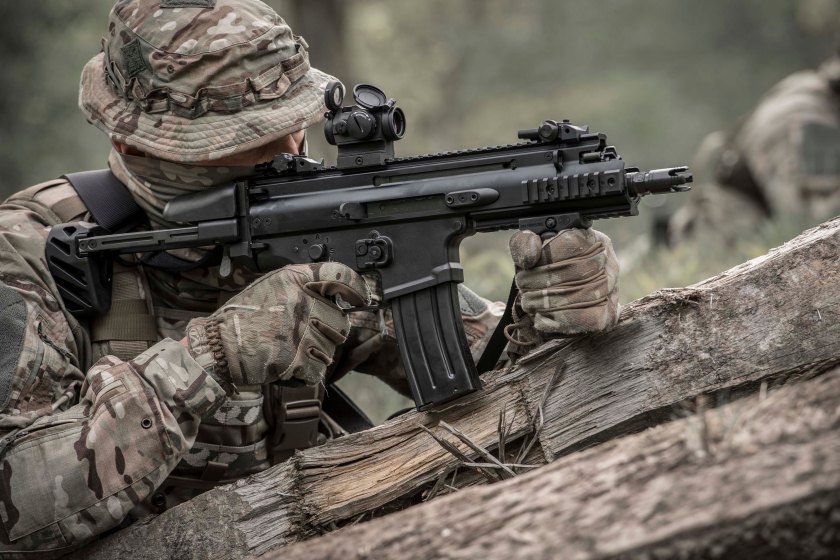
• FN SCAR L Mk 3
• SIG MCX LT
• Beretta NARP
• CZ / Colt Bren 3
• Knight’s Armament Company KS-1
All of these weapons with the exception of Knight’s Armament Company features a short-stroke piston-operated system. The HK 433, SCAR L, SIG MCX LT, Beretta NARP, and CZ Bren 3 are all broadly based on the same design as the AR-18 developed by the American ArmaLite company by Arthur Miller, Eugene Stoner, George Sullivan, and Charles Dorchester in 1963 as an alternative to the Colt AR-15 design. The HK416 is a piston-operated version of the M4 rifle while the KAC KS-1 is direct gas impingement weapon.

Generally, piston-operated weapons tend to be more reliable and able to sustain a high rate of fire for longer before a critical malfunction than direct gas impingement weapons. This is because heat build-up is accelerated by direct gas impingement systems that blows gas back into the action. It seems likely that a piston-operated weapon will be selected, but all of the above weapons are high quality products that would service the British Army well.
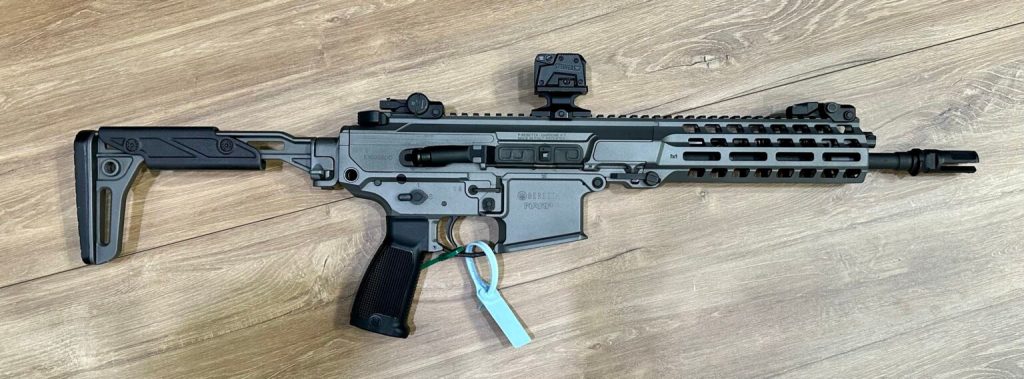
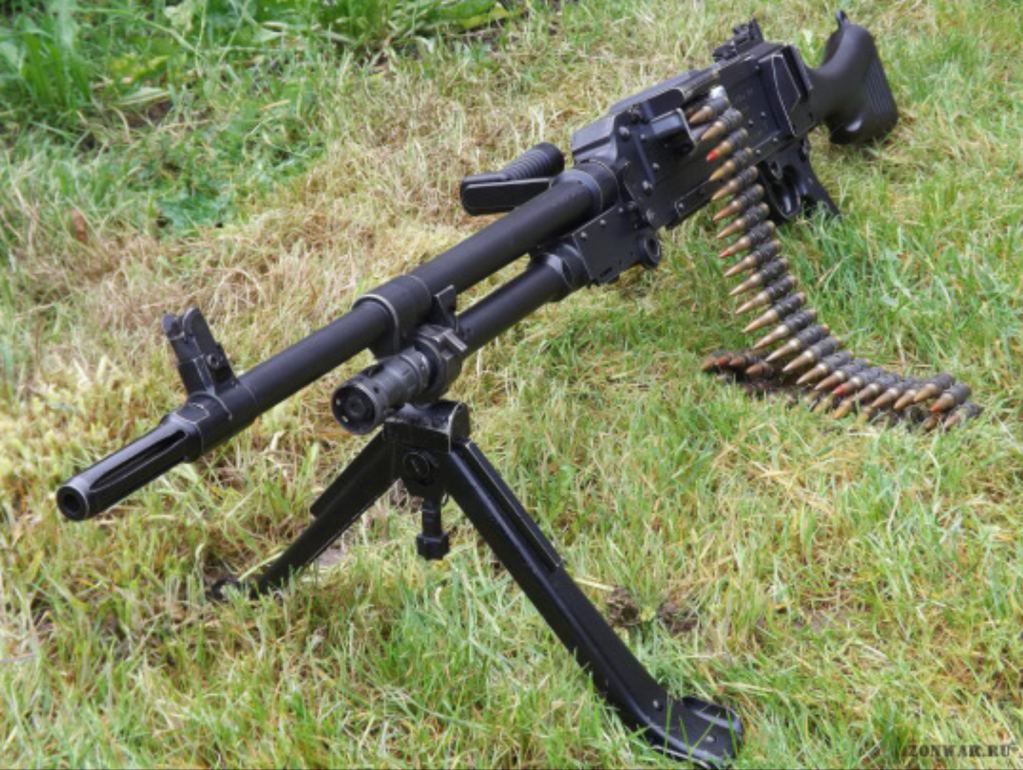
In terms of replacing the L7A2 GPMG in the light role, it’s a hard act to follow. Based on the FN MAG 58, this is the most widely used machine gun in NATO. However, it is a heavy weapon that imparts a significant weight burden on dismounted troops. It will be retained in the support role, but the Army is looking for a lighter 7.62 mm machine for infantry sections. There are fewer choices here:
• FN EVOLYS
• FN MINIMI
• HK MG5 / HK421
• SIG M250

02. How we got to where we are today?
The two existing NATO small arms calibres, 7.62×51 mm and 5.56×45 mm were both controversial choices when first introduced. Despite several attempts to replace them, they remain in service and have more than proven themselves in combat.
The American T65 7.62×51 mm cartridge was selected as the first NATO standardised cartridge in 1953. This was based on a shortened version of the .30-06 Springfield cartridge used by the US Army during both world wars. The British argued that the proposed 7.62 mm cartridge was too powerful, too heavy, and had too much recoil. Instead they proposed a radical intermediate .280 / 7×43 mm cartridge which the US rejected for being under-powered. The US Army’s influence within what was then the newly formed NATO alliance and its preference for 7.62 mm led to its adoption. However, within 10 years of it being selected, the US Army introduced a second cartridge, the .223 Remington, which was significantly less powerful than the British .280. The new .223 cartridge was subsequently adopted as the SS109 / M855 5.56×45 mm cartridge when it became the second NATO standard calibre in 1979.
The introduction of small calibre high velocity (SCHV) ammunition, for which 5.56 was the defining example, was driven by two important studies in the 1950s. The famous Hall and Hitchman reports concluded that 90% of small arms exchanges occurred at ranges below 300 metres, and that, if soldiers could be equipped with a rifle that fired a smaller, lighter cartridge, they would be able to carry more ammunition for a given weight and thus have a better chance of hitting a target. It was an elegant concept and the 5.56 AR-15 Armalite rifle developed by legendary gun designer Eugene Stoner brought it to life perfectly.
Between the adoption of the new NATO standard SS109 5.56×45 mm cartridge in 1979 and its use by coalition forces in Iraq and Afghanistan from 2002 to 2014, there was very little operational feedback on its performance. Over a 10-year period, the first extended combat use of this calibre provided a wealth of data from regular and special forces users.
The first major finding was that small arms engagements often took place at longer than expected ranges. Helmet-mounted camera footage showed that firefights occurred at distances of up to 900 metres, with enemy insurgents opting to use full-bore Russian 7.62x54R weapons precisely because they knew these could out-range Western forces equipped with only 5.56 mm weapons. With 5.56 mm ammunition it was difficult to engage targets effectively beyond 300 metres, not because the ammunition wasn’t lethal at longer ranges, but because the small 4-gram bullet kicked-up much less dirt than 7.62 mm and was prone to wind drift. A reduced striking signature meant that observing fall of shot was more difficult. When you cannot see where your rounds are landing, it’s hard to adjust your point of aim.
The second issue with 5.56 mm ammunition was that the US Army’s M855 loading could easily be stopped or deflected by intermediate barriers between the shooter and the target, particularly the windscreens of cars driven by suicide bombers, but also by thick foliage and masonry. The M855 muzzle velocity of 930 metres per second was intended to cause it to fragment and thus transfer its energy into the target. This was not an issue with the M-16 rifle’s 18” barrel, but rounds fired from the M4 carbine’s shorter 14.5” barrel had a lower velocity and were found to be less reliably lethal. Many European armies preferred to use ammunition that complied with their interpretation of the Laws of Armed Conflict, i.e. ammunition with full metal jacket projectiles that did not fragment or upset. But this resulted in 5.56 ammunition that caused “through-and-through” wounds, where a bullet passed completely through a target without transferring significant energy or inflicting damage.
It has also become evident that Hall and Hitchman overlooked another important factor: the role of small arms in suppressing enemy targets. This frequently needs to be done at longer ranges than 300 metres to allow infantry to manoeuvre into an assault position. This was relevant to the wide open spaces of Afghanistan 2006, but is equally applicable to the featureless steppes of Eastern Europe today. Infantry tactics still require sections and platoons to provide covering fire while sub-units outflank the enemy by moving under cover. Suppression studies have shown that larger calibres suppress more effectively than 5.56 mm due to their increased striking signature.
For the above reasons, we witnessed the wide-scale re-adoption of 7.62 mm weapons and ammunition at platoon and squad level. In particular, 7.62 mm designated marksmen rifles became popular while 7.62 mm general purpose machine guns were used instead of 5.56 mm light machine guns.
Few soldiers complained about the performance 7.62 mm ammunition. It could easily hit targets at ranges above 1,000 metres and, with a 9.5-gram bullet, lethality was never a concern. The problem was ammunition weight and recoil. At 24 grams, a 7.62 mm cartridge weighs twice as much as a 5.56 mm one, so a soldier equipped with a 5.56 mm weapon can carry twice the amount of ammunition for a given weight. In terms of recoil, 5.56 mm ammunition has a barely noticeable 4.7 joules of energy in a 14.5” carbine, while 7.62 mm ammunition has 16.8 joules in a 16.5” rifle, which is a significant thump in the shoulder.
While the conflict in Afghanistan continued, the US Army decided to develop an improved loading for its 5.56 mm M855 ammunition. Dubbed the M855A1 EPR (enhanced performance round) this delivered better performance out of shorter barrels. The success achieved with 5.56 mm EPR ammunition led to improved versions of the US Army’s M80 7.62 mm ammunition. Many European members of NATO, including the UK, have now developed their own improved loadings for both calibres.
All things considered, 5.56 mm ammunition now undoubtedly delivers reliable performance below 300 metres. It is still effective at 500 metres. And expert shots can hit targets at 700 metres and beyond. Those who support the SCHV concept contend that a hit anywhere with a 5.56 mm projectile is always better than a near miss with 7.62 mm one, and, as noted above, with more rounds carried, you have a higher hit probability. For these reasons, most NATO armies remain fully committed to this calibre.
In effect, NATO has effectively adopted a dual calibre solution utilising both 5.56 mm and 7.62 mm weapons carried at section and platoon level. For short-range engagements, particularly final assaults and CQB, 5.56 mm weapons are perfectly adequate. For longer-range work, 7.62 mm designated marksman rifles and machine guns complement them, especially when such weapons are mounted on tripods or vehicles.
03. The quest for an optimised single calibre
As the war in Afghanistan started to wind-down, the US Army began to look to the future. In deciding whether to replace or upgrade the M4 carbine, it was pertinent to ask if the time had come to revisit the ideal calibre debate. Therefore, it conducted a calibre review, the Small Arms Ammunition Configuration (SAAC) study in 2017. Like so many “ideal calibre” studies before it, this again concluded that a round somewhere between 6 mm and 7 mm would achieve an optimum balance between range, lethality, weight and recoil.
In 2018, the US Army mooted a potential switch to a new standard calibre. This generated much excitement. Would we get a single calibre solution at squad-level? Would it be a “back to the future” reboot of something like the ill-fated British .280 cartridge developed in the late 1940s? And would this new round finally replace 5.56 mm after 60 years of service?
At the same time, US SOCOM was experimenting with its own new ammunition types. This resulted in three new calibres being issued to special forces on a limited basis. The first of these was the 6.5×48 mm Creedmoor, developed by US ammunition company Hornady. This had the advantage of using the same case as 7.62×51 mm necked-down to 6.5 mm, meaning that it could be used in 7.62 mm weapons with just a barrel change. Operational testing showed that 6.5 mm Creedmoor shoots flatter, faster, and further than 7.62, making it ideal as a sharpshooter calibre. It also weighs 20% less than 7.62 mm with lower recoil. In fact, it is superior to 7.62 mm across every key metric. The widespread adoption of 6.5×48 mm Creedmoor among NATO special forces users underlines its growing popularity.
The US Army Marksmanship Unit developed a second new ammunition type, the .264 USA. This also delivered markedly superior performance to 7.62 mm, but in a smaller package than 6.5 mm Creedmoor. The .264 USA cartridge has since evolved into the 6.5×43 mm Lightweight Intermediate Calibre Cartridge (LICC). This is now packaged in a shortened 7.62 mm case and bears an uncanny resemblance to British 7×43 mm (.280/30) ammunition. The new 6.5 mm LICC cartridge is now being evaluated by US SOCOM in rifles and machine guns.
In 2020, US SOCOM began to experiment with a third ammunition option, the 6 mm ARC. Also developed by Hornady, this used the 6.5×39 mm Grendel cartridge necked-down to 6 mm. It fits within the action length of 5.56 weapons so can be implemented with a barrel and bolt head change. Like 6.5 mm Creedmoor, 6 mm ARC delivers better long range performance than 5.56 mm NATO, matching 7.62 mm NATO out to 900 metres. At the same time, it is 30% lighter than 7.62 mm with significantly reduced recoil. Unfortunately, the larger diameter of the 6 mm ARC case creates weapon reliability issues, so needs further development. If any new calibre has the potential to replace 5.56×45 mm, then 6×39 mm is it.
As the US Army planned its next generation small arms program, five future calibre scenarios emerged:
Option 1 – Dual Calibre: maintain the status quo by retaining the two existing calibres, 5.56 mm and 7.62 mm, but develop new loadings, e.g. M855A1 EPR and M80A1 EPR.
Option 2 – Single Calibre: retain 7.62 mm only (and retire 5.56 mm), but develop two 7.62 mm loadings, low power and high power in an identical cartridge.
Option 3 – Dual Calibre: retain 5.56 mm and adopt a new calibre to replace 7.62 mm, e.g. 6.8×51 mm NGSW or 6.5×48 mm Creedmoor.
Option 4 – Dual Calibre: replace both legacy calibres with optimised ones, e.g., 6 mm to replace 5.56 mm and 6.5 mm to replace 7.62 mm.
Option 5 – Single Calibre: adopt a new single calibre to replace both 5.56 mm and 7.62 mm, e.g. 6.8×51 mm NGSW or 6.5×43 mm LICC.
Initially, the SAAC study findings suggested that the US Army would go for Option 5 and adopt a single calibre that would replace both legacy ammunition types. As we will see, its original intentions changed due to evolved user requirements. It selected Option 2, but has now chosen Option 3.
04. The NGSW program
Instead of trying to deliver 7.62 mm performance in a 5.56 mm package, the US Army’s Next Generation Squad Weapon (NGSW) program has changed the game completely. US RDECOM believed that the use of Level IV body amour1 by potential adversaries created a requirement for a more powerful ammunition to defeat it. It therefore developed a revised specification and a 6.8 mm projectile which it believed would penetrate Level IV body armour at 600 metres. This defined an ammunition that was equivalent to magnum sniping cartridges and something considerably more powerful than 7.62 mm NATO.
The US Army’s Next Generation Squad Weapons (NGSW) program initiated a three-way competition between Textron, GD-OTS, and SIG Sauer. It gave each vendor a very low drag (VLD) 6.8 mm projectile, but let them implement whatever technical solution they thought was best. By any objective measure, NGSW was an ambitious program. It included a new calibre, a new ammunition technology and two new weapons (rifle and automatic rifle / light machine gun). It also planned to introduce a new optical sight that would combine a laser range finder with a ballistic computer to increase first-round hit probability. Two vendors, Vortex and L3 Harris, competed for the weapon optic contract.
In April 2022, the US Army down-selected SIG’s ammunition and weapon solution, while Vortex was chosen to provide the optic. Initially, everyone thought the US Army had decided to play it safe by selecting an ammunition that was similar to legacy brass cartridge types. The much hyped Textron cased-telescoped ammunition system, which had been under development for more than a decade, was a disappointment. It just couldn’t deliver the mandated level of reliability and performance. Nor could GD-OTS’s ammunition and weapon combination. In fact, SIG created a truly innovative NGSW contender by developing a cartridge able to cope with much higher chamber pressures. In essence, SIG’s 6.8×51 mm cartridge incorporated .300 Winchester Magnum performance in a 7.62 mm package. Conceptually, this was able to meet the US Army’s future requirement, but in the eyes of many it is a specialised infantry cartridge, not a universal all-arms one.
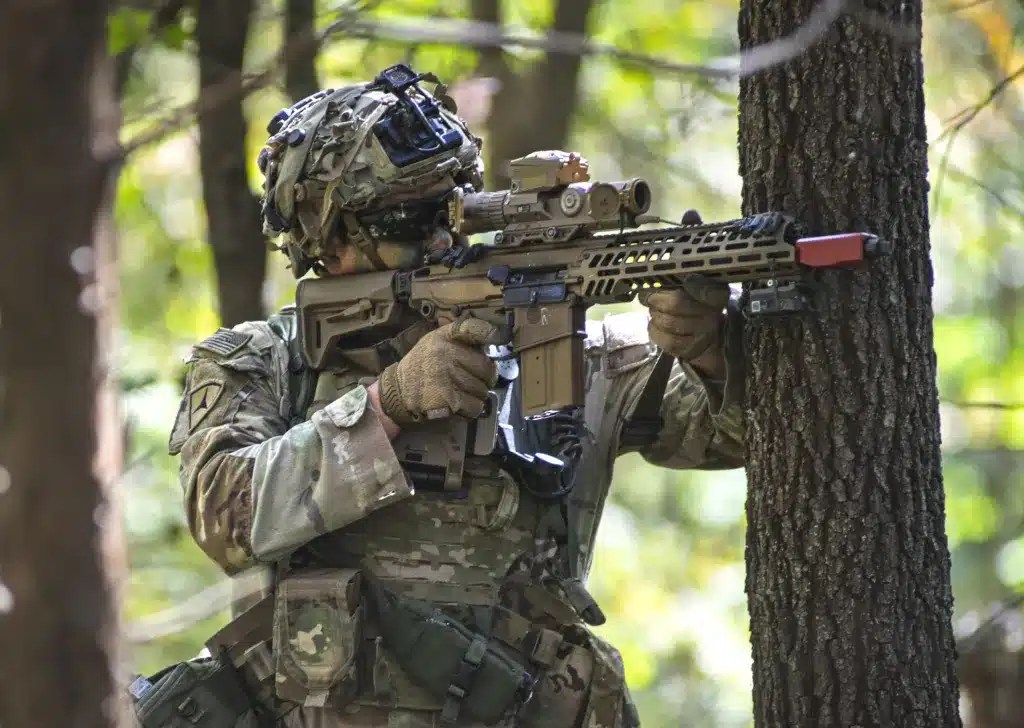
Since being downselected, SIG has worked closely with the US Army to fine-tune both ammunition and weapons to optimise performance. Three basic loadings have been developed: a general purpose (GP) round, a Special Purpose (SP) armoured piercing round and a reduced-range (RR) round for urban CQB and training. Blank, Tracer and Man Marker natures have also been added.
The NGSW objective, to penetrate Level IV (now RF3) ceramic plate armour at 600 metres, was a huge ask. It required the 6.8 mm VLD projectile to be fired at a velocity of 3,000 feet per second from a 13” barrel, so that it retained the necessary velocity to punch a hole through body armour. This in turn led to a weapon chamber pressure above 80,000 psi – well in excess of legacy ammunition types.
To cope with the increased pressure, SIG developed a hybrid two-piece cartridge with a brass sleeve and metal base. This in turn needed a more robust weapon to fire it. Getting the system to work has been a significant technical challenge. Even with a more durable weapon action, barrel life was initially only 7,000 rounds. This has now been increased to 10,000 rounds, thanks to exotic chrome linings, but is well short of a standard 5.56 mm barrel, which is good for 20,000+ rounds. Increased recoil, excessive fouling, toxicity issues resulting from gases being forced into the firer’s face when using suppressors, and parts breakages have all been issues. Also, the Vortex optic has not been as reliable as hoped. However, many of these issues should be expected, given vastly increased heat and higher pressure gases. It may simply be a question of time, commitment and technical problem-solving to get everything to work. As the program has progressed, SIG has been able to deliver increased levels of performance while addressing technical issues.
While NGSW is moving in the right direction, three serious deal-breakers have become apparent. One is that the new cartridge cannot actually defeat Level IV body armour at 600 metres, which is its fundamental purpose. The problem isn’t just penetration, but also long-range accuracy. Reducing the requirement to 300 metres is more realistic, because even if penetration can be achieved at 600 metres, the average soldier may struggle to hit targets consistently at this range, despite having an advanced optic, and especially when battle fatigue is factored in. The second deal-breaker is something never addressed by the original NGSW requirement, which is the need to reduce the dismounted infantry soldier’s weight burden. Versus, 5.56 mm, 6.8 mm NGSW adds to the overall combat load carried. The third deal-breaker is the one that may yet kill the NGSW program. This is affordability of the system as a whole, based not only on weapon and ammunition purchase costs, but also on training and through-life support costs. The XM7 rifle costs $5,000 and the XM157 smart optic is $18,000. In comparison, the existing M4 carbine plus optic together cost less than $2,000.
The consensus view is that the NGSW program is going to deliver a niche capability, rather than the universal small arms solution many hoped it would. Given a more specialised role, ongoing technical hurdles, and system cost, US military planners are going to have to ask themselves the question of whether the NGSW juice is worth the squeeze?
05. What if NGSW fails?
Looking at infantry small arms as a whole, NATO armies presently use a golf bag of weapons and calibres:
- 7.62×51 mm – Rifle, Designated Marksman Rifle, General Purpose Machine Gun
- 5.56×45 mm – Assault Rifle, Carbine
- 9×19 mm – Pistol, Sub-machine gun
- 5.7×28 mm – Pistol, Personal Defence Weapon
- .338 Lapua / Norma magnum (8.59 mm) – Precision rifle and Medium Machine Gun
- 12.7×99 mm – Heavy Machine Gun, Anti-Materiel Rifle
A new calibre will not replace any of the above ammunition types, merely add to the toolkit of available calibres and weapons already in service. If NGSW does not proceed for any reason, there are a variety of fallback options.
A hybrid case version of legacy 7.62 mm NATO could potentially deliver increased range and lethality with marginally increased recoil and a slight reduction in weight. Second, a hybrid version of 6.5 mm Creedmoor could deliver increased performance with less recoil and weight than 7.62 mm. Third, a hybrid 5.56 mm cartridge could also deliver increased performance with an insignificant increase in recoil and less cartridge weight. Therefore, the cancellation of 6.8 mm NGSW in favour of the wider adoption of hybrid case technology might still be a win for the US Army. In any situation, we are likely to see legacy calibres retained at squad and platoon level for the foreseeable future.
So what about other alternate calibres? The 6 mm ARC round and other 6 mm developments have shown their capacity to deliver increased performance within the action length of 5.56 mm weapons. These could be adopted with little more than a barrel and bolt head change, but would need further development. In the eyes of many, an optimised 6 mm loading would be the ideal long-term replacement for 5.56 mm. Similarly, several 6.5 mm loadings, including 6.5×48 mm Creedmoor and .260 Remington, fit within the action length of 7.62 mm weapons, so could potentially replace the latter. However, moving to 6 mm and 6.5 mm (Option 4 in the future calibre scenarios listed above) does not change the basic dual calibre model that has emerged. So it may be a case of diminishing returns.
Another option to replace 5.56 is to adopt a PDW calibre, such as 5.7×28 or 4.6×30, these allow smaller, more compact weapons to be used. These would be ideal for helicopter and AFV crews, commanders, radio operators and infantry who have to carry support weapons.
While the US Army continues to refine NGSW, US SOCOM has adopted 6.5 mm Creedmoor in assault rifles, machine guns, and designated marksman rifles. It is also exploring other hybrid ammunition concepts that could potentially replace 7.62 in a more compact, lighter package. FN America’s 6.5×43 mm LICC cartridge (see above) uses a lightweight steel case developed by ShellShock. This is an Option 5 attempt to field a universal cartridge. If successfully fielded by SF units, it could gain wider support elsewhere. Freed from budget constraints and politics, SF users can choose whatever they like and validate the concept through actual combat use.

For the moment, the jury is still out on whether 6.8 mm NGSW is viable. It is not certain that it will succeed. Nor is it inevitable that it will fail. Indeed, development issues could lead to a revised specification that makes it usable. We could see a new loading with a lower chamber pressure, perhaps even in a conventional brass case (like the .277 Fury).
06. Where does this discussion leave the British Army?
The British Army’s Project Grayburn and Project Cairns envisage a new rifle and light machine gun replacing the current L85A3 rifle and L7A2 GPMG respectively. It has stated an intention to retain both legacy calibres. Whatever replaces existing small arms is likely to remain in service for the next 40 years, so procuring new 5.56 mm and 7.62 mm weapons in a hurry, could be a missed opportunity if NGSW lives up to the hype and becomes a new NATO standard calibre, or, more important, if the need to penetrate Level IV body armour becomes urgent.
While it may not be right to adopt NGSW or any new calibre at this stage, given the US Army’s budget and significant influence within NATO, the chances of NGSW not proceeding are slim.
Whatever happens, it seems inevitable that some flavour of 6.x mm will ultimately replace 7.62 mm. It is likely to take 12 to 24 months before a final 6.8 mm NGSW specification is defined. Therefore, it may be a wise decision to postpone any future British Army small arms acquisition decision until the future of 6.8 mm NGSW is settled.
The British Army already has multiple capability gaps, so the benefits of adopting a new small arms calibre and weapon system need to be measured against other priorities. Small arms are important, for sure, but they are NOT the primary delivery mechanism of battlefield lethality. This questions the wisdom of developing a new small arms system designed to defeat body armour at ranges well beyond the shooting ability of the average soldier. Arguably, a better approach might be to rely on artillery, mortars, heavy machine guns, vehicle-mounted cannons, and FPV drones, to deliver greater effect. This means, irrespective of the technical prowess of any alternatives to 5.56 mm and 7.62 mm, any new calibre needs to be compared to weapons other than small arms.
What can be said definitively is that regardless of what happens with 6.8 mm NGSW, 5.56 mm ammunition and weapons will need to be retained for non-infantry personnel. As noted above, enhanced performance loadings have reliable lethality to at least 300 metres. If a 6.8 mm or 6.5 mm ammunition is adopted and used more widely than 7.62 mm, as noted above, it may be possible to replace 5.56 mm with a PDW calibre.
For the moment, we should expect 5.56 mm to remain in service and 7.62 mm to be used until it is replaced by 6.8 NGSW or another 6.x calibre. In other words, a dual-calibre solution will persist. This being the case, it would make sense to acquire a modular weapon family that can be chambered in multiple calibres as this will simplify training and support. So, something like the Heckler & Koch HK416 and HK417, FN SCAR L and SCAR H, or SIG MCX Spear and MCX LT, all make sense.
In the short-term, any acute need for new 5.56 mm weapons could potentially be addressed by acquiring additional L85A3s. Heckler & Koch did a good job upgrading the rifle to the present standard, so it is likely to be straightforward to upgrade additional weapons. Also, the Project Hunter programme has resulted in the excellent Knight’s Armament KS-1 assault rifle being selected for Ranger and Commando units. Simply buying more of these and issuing them more widely could be expedient. The problem with both more L85A3s and KS-1s is that neither is manufactured locally.
Ultimately, Project Grayburn and Cairns are not merely concerned with selecting appropriate new small arms calibres and weapons, but also identifying an industrial partner who is willing to make the necessary investment to reconstitute a sovereign capability to mass produce small arms.
FULL DISCLOSURE: The Author of this article has previously advised Heckler & Koch and FN Browning. He is not currently advising any small arms manufacturer and has not been paid to endorse or critique any weapon mentioned in this article.
Notes:
- The US National Institute of Justice (NIJ) has now reclassified body armour standards, so what was Level IV is now RF3 under the NIJ 0101.07 classification. ↩︎
 UK Land Power
While the rational for 6.8 was to defeat body armour in a high intensity conflict, what I am seeing in Ukraine is a caliber suited for automatic fire in trenches and short ranges.
Dropping from 30 rounds to 20 in a magazine seems problematic to me.
I lean towards your option 3, keeping 5.56 and combining LMGs and GPMGs into a 6.8 MG.
Am I drawing the wrong lesson from Ukraine? I’ve not heard any discussion about the performance of body armour. Has anyone else heard anything?
LikeLike
I’ve seen reports/speculation ‘soft’ body armour is increasingly important in Ukraine due to the threat from drone munitions – flying grenade fragments, more so than from direct bullet impacts and the need for ‘hard’ armour plates.
LikeLike
You are spot on with your comments. 5.56 mm has proved to be a better calibre for trench clearing in Ukraine for exactly the reason you specify – you carry more rounds per magazine. Add to this that Russian body armour is not widely issued and where it has been seen the quality of the plates was terrible. Chinese body armour may be a different story. Regardless I remain skeptical about whether small arms ammunition should be optimised to penetrate Level IV body armour – the energy required results in a heavy weapon with significant recoil.
LikeLike
I’m not sure the war in Ukraine can be held up as an example of how the West (US) would fight the next war. From my perspective, the war in Ukraine has primarily been a ground war with “air support” provided by drones and very little use/coordination of air assets because frankly, up until recently, Ukraine hasn’t had them. This appears to be starting to change as the West supplies them with aircraft and Ukraine pilots finish training but that’s a discussion for another article…..
The West, particularly the US, trains and fights with a high degree of integration between air and ground assets so while there may be some “trench fighting” I see that as the exception rather than the rule as we’d much rather pummel the trenches with SDBs and such rather than fight through them. How did we (Coalition) fight in GW1? How did the US fight in GWOT? Air assets, be it attack helos, strike fighters, gunships, bombers, etc. were almost always integrated into the battle plans and made available to the ground units.
US “style” is to “hit them from range” since the further away they are engaged, the less likely US troops will get hurt. 5.56 doesn’t fit that bill anymore, especially with optics becoming more widespread allowing opponents the opportunity to accurately engage from longer ranges. I don’t know what the answer is, to me it seems like 6.8 NGSW since the Army removed the X, but I do know, or at least my opinion is, that it isn’t 5.56.
LikeLike
Infantry will still be required to close in and kill the enemy even if a fortified area has been pummelled requiring clearing. The personal weapons typically are personal defence weapons with typical engagement ranges that haven’t seemed to change drastically since WW2 and even in Afghanistan with the advancements in optics. Therefore this weapon should be capable of being a personal defence weapon but be used in CQB and maintain ammunition that can be carried in volume.
Small arms as effectors are typically at the Platoon/Section level and the range will still be provided by the GPMG and DMR (or equivalents) alongside other systems (Carl Gustav, NLAW etc). Suppressive fire is constantly returned to whenever the warfighting laboratories experiment with sharpshooting – even the USMC experience cannot be drawn on as they have a weapons squad at the Platoon level.
Small arms should not be the priority when the gain is so marginal compared to fires. If anything improving the support weapons at the Platoon/Section level would be better.
LikeLike
How many SDBs are in inventory now that most of its stock has been repurposed to be fired out of HIMARs as GLSDB?
With flashpoints in Taiwan, or a catastrophic escalation in the Strait of Hormuz or God forbid, tac nukes over Ukraine, trench fighting and urban house to house and hand to hand fighting is if anything more, not less likely. Especially in an environment where aircraft are no longer viable as a strike platform: Operation Rough rider exposed the USAF and USN as completely ineffective against the fourth poorest country in the world. Not even dropping MOABs on Houthi positions could stop the blockade of the Red Sea.
This leaves ground warfare and drones. In other words Ukraine IS the future of warfare whether you like it or not: denied airspace for both sides from highly lethal air defence, swarms of suicide drones, motorcycle dragoon trench raids, FASCAM remote mining denying the use of heavy armour, house to house and hand to hand.
LikeLike
“The XM7 rifle costs $5,000 and the XM157 smart optic is $18,000. In comparison, the existing M4 carbine plus optic together cost less than $2,000.”
Nick, while accurate, I believe the cost comparison between M7 and optic and M16/M4 and optic is a bit of an apples to oranges comparison in my opinion. You are comparing the cost of a weapon and optic that are still trying to recover NRE cost to a weapons and optic that have been produced for 30 years or so and as such are no longer trying to recover NRE and have optimized production to reduce production costs as much a possible. Additionally I would not lump the weapon and optic together since the XM157 could just as easily be used with an M4 or L129A2.
So looking at the rifles separately, assuming the M7 follow a path similar to the M16/M4, looking into my crystal ball 30 years into the future I could see the M7 costing ~$2000 in today dollars, yes an increase over the current M16/M4 cost but not the steep present day premium of $5000.
As far as the optic goes, we both know that battlefield electronics don’t come cheap. **cough** Ajax **cough**. I’m not even going to try to predict what the XM157 would cost in 30 years but I would say that M7 could be pairs with an LPVO similar to what is currently issued with some rifles for ~$1000.
So long story short I could see an M7 and conventional optic costing around ~$3000 once NRE is recovered and production is optimized.
Of course this is coming from and aerospace engineer watching from the sidelines who really likes the new, caliber agnostic, ammo tech that Sig developed.
LikeLike
The XM7 is way too expensive and still has major reliability issues — high pressure rounds causing fouling, short barrel life, excessive weight, and it still can’t reliably defeat Level IV armour at 600m. Why not go with something proven like the HK416, SIG MCX LT, Beretta NARP, or especially the KS-1, which our own Royal Marines already use? They’re cheaper, modular, reliable, and use standard 5.56mm — no need to overhaul the entire system. If the NGSW isn’t delivering what was promised, why force it into general issue?
LikeLike
I think 6mm Arc is the round of choice here, but it’s a tough decision, as I go round in circles due to the logic you have correctly highlighted in this article.
5.56 shockwave offers 10% improvement over current rounds, but 6mm Arc is another beast totally & offers far better lethality and distance.
where I have got to is stick with 5.56mm for the first 20-50k units of Grayburn and then finalise the calibre for the remaining 150k units and cycle from infantry backwards.
if we have sovereign capability, potentially doing the barrels at Sheffield forgemasters (as I am sure they have other uses for the equipment as well), then we can upgrade the whole inventory to the selected “super calibre” at a later date.
looking at the contenders, Berretta NARP is starting to stand out from the crowd, but you also can’t fault the KS1 setup the RMC selected.
this is going to be very interesting
great article Nicholas, bang on the money
LikeLike