
Nicholas Drummond
How the British Army’s next war will actually be fought — a scenario set in the Courland Peninsula, January 2030
This article imagines what happens if the British Army finds itself unexpectedly deployed in support of NATO. It describes a fictional operation in Latvia after Estonia and the British forces based there have been lost to a Russian hammer blow. This account tests the UK’s future force design through a detailed and realistic scenario. The events below are fiction. The lessons behind them are not.
The road to Courland
The scenario requires four assumptions to be accepted, each is uncomfortable but none is beyond the bounds of possibility.
First, that the war in Ukraine ends in February 2027, not with peace but with an armed pause — a fortified line, a fragile truce, and two armies glaring at each other across it. Second, that Russia does not demobilise. Instead, following a decisive rupture in US–China relations, Beijing abandons its careful ambiguity and openly underwrites Russian reconstitution: machine tools, drone components, artillery energetics, rocket artillery, cruise and ballistic missiles, and the industrial plant to mass-produce all of them. By late 2029 Russia fields 600,000 troops opposite Ukraine and a second force of similar size for use elsewhere — an army that is large but uneven. It has a hardened core of veterans, but its assault formations, fires and drone formations are wrapped in hastily trained mass, because China can export machine tools, but not a non-commissioned officer corps.
Third, that NATO air power and Russian integrated air defence fight each other to a standstill. Layered S-400 / S-500 belts thickened by Chinese-supplied SHORAD make manned aviation over the front line prohibitively costly for both sides. Air power retreats to stand-off strike and the defence of national airspace. The consequence is profound: the land force must generate its own reconnaissance, its own precision fires, and its own air defence, organically, or it has none. Every design choice that follows flows from this single assumption.
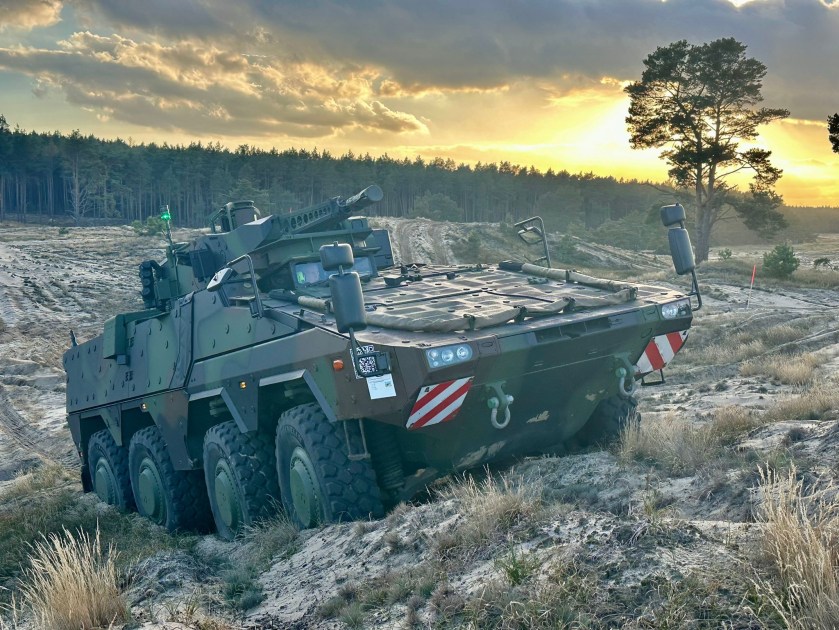
Fourth, that the British Army has spent 2026–2029 doing what the Defence Investment Plan implied rather than what inertia preferred: regenerating 1st (UK) Division as a genuine wheeled expeditionary formation, based forward in eastern Germany, built around Boxer, and structured on the 20:40:40 principle — 20 per cent crewed platforms, 40 per cent reusable uncrewed systems, 40 per cent consumable munitions and drones. The key addition here is the prioritisation of 1st (UK) Division as a wheeled expeditionary force equipped with Boxer, including a turreted version for ISTAR, SHORAD, and Overwatch.
On Christmas Eve 2029, Russia attacks the Baltic states. The assault is preceded by the heaviest drone and missile strike in European history and succeeds within 48 hours; the British battlegroup in Estonia is destroyed in place. Poland counter-attacks immediately, recovering Lithuania and driving into Belarus, where the massing Russian follow-on forces are fixed in a grinding operational-level battle that becomes NATO’s main effort. A state of war exists.
And so, in the second week of January 2030, 1st (UK) Division crosses into Latvia with a task that reads simply on the operational order and enormously on the map: clear Russian forces from the Courland Peninsula — Kurzeme — from the Baltic coast to the approaches to Riga. Some 13,000 square kilometres. One division.
Anyone who knows the military history of this ground will pause at the name. Courland is where Army Group North was cut off in October 1944 and held out, supplied by sea, until the last day of the war in Europe. The peninsula makes pockets. The division’s commander knows this, and it shapes everything she does.
Day One: the First Battle
The division does not advance so much as extend. There is no phase line of vehicles rolling forward in tactical bounds. Instead, along the A9 axis from Liepāja towards Riga, the formation stretches itself into the peninsula like a nervous system growing into new tissue — sensors first, then fires coverage, then, last of all, people.
The First Battle — the fight to see, to blind, and to kill at reach before formations ever touch — has been under way for thirty-six hours before a single infantry Boxer moves. It is fought almost entirely by the artillery brigade, and above all by its strangest and newest unit: a cavalry regiment that owns no armoured vehicles at all.
The drone regiment fights from unremarkable Toyota 4x4s dispersed across farmsteads and forestry tracks fifteen kilometres behind the leading edge, its survival resting not on armour but on being indistinguishable from the civilian traffic of a country at war, and on a signature discipline so severe that its squadrons transmit nothing from their actual locations — every emission is backhauled by fibre to antennas sited kilometres away. Its Class II fixed-wing ISR orbits stare down at the Courland road network in overlapping shifts. Its one-way attack munitions — the consumable 40 per cent, racked in the backs of trucks like the artillery ammunition they conceptually are — wait for the targeting cell to spend them. Its decoy flights fly deliberately provocative profiles to make Russian air defenders switch on, and its electronic support troop fixes them the moment they do.
The regiment’s daily consumption of airframes is briefed to the divisional commander each evening alongside artillery ammunition and fuel — because that is what it is: ammunition. On Day One the division expends over four hundred uncrewed systems. Nobody writes a letter to a family about any of them. This, more than any platform, is what 20:40:40 means: the division has moved attrition off its people and onto its inventory.
What the drones find, the kill web kills. The phrase “kill chain” has quietly fallen out of use in the division — chains break at a single link, and the enemy’s entire electronic warfare effort is devoted to breaking links. What the division now operates instead is a web. Every sensor in the formation — a section’s plate-sized quadcopter, the counter-battery radars, a Giraffe 1X on a Dingo, the German brigade’s sensors to the east, a Polish F-35 feed arriving through the corps fabric — publishes into a single sovereign data layer riding on proliferated LEO satcom, self-healing tactical mesh, and, when everything else is jammed, high-frequency radio that would be recognisable to a signaller from 1944. Every effector subscribes. No single bearer is trusted; the fabric routes around damage without being told to.
The measurable output of this architecture is a number the division tracks the way a previous generation tracked rounds per gun per day: sensor-to-effector latency. When a Russian 2S43 self-propelled gun north of Skrunda fires its third mission of the morning and begins to displace, the sequence runs: detection by an ISR orbit; machine-assisted classification and geolocation in seconds; the fires cell’s decision-support tool nominating the optimal effector — a pair of RCH155 howitzers 40 kilometres away with a solution and BONUS in the racks, versus a loitering munition already airborne, versus a GMLRS pod that would be extravagant; a human fire controller approving with a single action inside a pre-cleared kill box. Rounds land ninety-four seconds after detection. In 2022 that took half an hour, and half-hours were what kept Russian artillery alive.
The artificial intelligence in this loop does four jobs and refuses a fifth. It fuses tracks into one correlated picture; it flags anomalies — why has all Russian voice traffic on the Saldus axis stopped?; it generates and wargames branch plans faster than the plans cell can read them; and it predicts, with unsettling accuracy, which vehicles will break down and which units will run short of 155 mm two days hence. It does not decide to kill. Lethal authority remains with tired majors and corporals, which is where the division’s doctrine, its lawyers and its conscience all agree it belongs.
Day Two: contact at Kuldīga
The pattern of the advance has, by the second day, become almost rhythmic. Infantry battalions move dispersed — never more than a platoon’s worth of Boxers visible in any drone’s field of view — under a travelling canopy of their own small ISR drones. When resistance is found, the infantry halt, disperse further, and go firm. The fires system degrades the position. Then, and only then, do infantry and cavalry close to occupy ground that has already been substantially decided.
At Kuldīga, the pattern meets its first serious test. A Russian battalion tactical group from one of the veteran formations — not the brittle mass, the hard core — has folded itself into the town’s outskirts and the wooded high ground east of the Venta river, with a company of BMP-3s, dismounted infantry in the buildings, at least a battery of 152 mm in depth, and a dense local drone and EW umbrella.
B Company, 1st Battalion the Royal Regiment of Fusiliers, finds them the honest way: a section’s micro-drone spots a thermal bloom in a treeline that the pattern-of-life analysis said should be cold, and ninety seconds later an anti-tank guided missile penetrates the lead Boxer of the point platoon. The vehicle is hit but does not die — the crew compartment holds, the blast seats work, two soldiers are concussed and every other man walks out of the back under his own power and into a drainage ditch. This sentence, unremarkable as it reads, is the entire vehicle-protection argument compressed into a single event, and we will return to it.
What happens next is the Second Battle, and it is worth walking through slowly, because it is here that doctrine either works or gets people killed.
The company commander, Major Tom Waite, does three things in the first five minutes. He pushes his platoons into dispersion and cover — no manoeuvre, no heroics, the instinct to “assault through” trained out of the infantry years ago for situations like this. He launches the company’s fibre-optic FPVs — jamming-immune, trailing their gossamer threads over the frozen fields — to fix the enemy’s positions in detail. And he calls for fires into kill box SABRE THREE, an authority pre-delegated to him personally, in writing, two days earlier.
Then the Russians do what competent Russians do: they take the electromagnetic spectrum away from him. A concentrated EW strike collapses the company’s mesh network, jams GNSS across ten kilometres, and cuts B Company off from battalion, brigade and division simultaneously.
And here is the point that every discussion of digitised warfare eventually reaches and most flinch from: the network will fail, repeatedly, at the worst moments, and the force must be designed on the assumption that it does. Mission command in 2030 is not a cultural preference or a nod to Auftragstaktik in a doctrine note. It is a physical necessity. Tom Waite fights the next six hours on three things: the divisional commander’s intent, which he can recite because it is one paragraph long; control measures and fire authorities issued before the battle; and his own judgement. His fibre FPVs, immune to the jamming, keep finding targets. His pre-cleared kill box means the dual RCH155 gun sections working the area — never a battery gun line, always single or double guns firing from farm tracks and displacing inside the Russian counter-battery clock — keep serving him without needing to speak to him. BONUS sensor-fuzed rounds, hunting in pairs over the woods east of the river, account for five BMP-3s in the first hour. The company’s own 30×113 mm cannons fitted to their Boxers, firing proximity-fuzed airburst, strip away the Russian FPV waves that come hunting the halted infantry; what leaks past the cannons meets the netting and standoff screens on the Boxers, and of eleven drone strikes on the company position that afternoon, two achieve mobility kills, through lost wheel stations that will later be repaired, and none achieves a catastrophic one.
Six hours later, when the divisional EW effort has found and fires have killed the Russian jamming complex — direction-finding to grid, GMLRS to target, the counter-C2 fight in miniature — the network heals itself, and Waite’s report is waiting in the fabric before brigade has finished asking for it. The moment the battle turned, the divisional commander says later, was not any single strike. It was a company commander, cut off, executing intent he had been trusted with in advance. Every technology in the division exists to make that moment survivable. None of them replaces it.
The cavalry, meanwhile, have been fighting a different war entirely. The two Boxer RCT30 regiments do not lead the advance in any sense a 1944 or even a 2003 cavalryman would recognise. They manage the empty battlefield — the fifteen-kilometre-deep zone forward and flanking, populated mainly by sensors, scatterable mines and drones, in which they are the only persistent human presence. They confirm what the drones report and, more importantly, investigate what the drones cannot explain; passive collection can be jammed and deceived, and someone must still be able to fight for information. They kill the Russian reconnaissance effort — the enemy’s own First Battle — with 30 mm airburst against the drone waves and with tube-launched Altius 600M-class effectors against anything on the ground, a squadron leader now commanding organic surveillance-strike reach to a hundred kilometres, doing with a rack of loitering airframes what an attack helicopter squadron did a generation ago at a hundred times the cost and risk. They are never static longer than the counter-battery clock allows. Their survival mechanism is motion, dispersion, and the hard-kill active protection systems that the division could not yet afford to fit fleet-wide and therefore fitted, correctly, to the vehicles that live furthest forward.
Day Three: the new line, and the manufactured fortress
By the third morning, Kuldīga is clear, the surviving Russians withdrawing east towards Saldus, and the division makes a decision that would have seemed eccentric to its grandfathers: having won ground, its infantry immediately dig in as though expecting to lose it.
Except that “dig” is no longer the word. Digging is what gets infantry killed in 2030 — an excavator working a treeline is visible to enemy ISR for the days it takes to complete a position, and the position is registered for fires before it is occupied. What arrives instead, that night, on the backs of the logistic brigade’s load-handling trucks, are fortifications as a manufactured product: modular precast and printed concrete fighting positions and overhead-cover sections, rated against FPV strike and 122 mm fragmentation, emplaced by a specialist fortification group of the force support engineer regiment, bermed over by plant in hours and thermally cold by dawn. A defensive line that Ukrainian experience priced at two weeks of visible, lethal labour has been emplaced in forty-eight hours, most of it in darkness. The infantry of the light mechanised brigade, in their Dingos behind the new line, now hold ground the way this war demands ground be held: dispersed, subterranean, stubborn, and cheap to sustain — while the Boxer brigades, relieved of the line, coil back into hides as the divisional reserve and the instrument of the next advance.
Above everything, unglamorous and continuous, the air defence battle proceeds on a principle the gunners describe as economics with radars. The layered system engages cheapest-first: soft-kill jammers and the infantry’s own cannons against the drone mass; the Skyranger 35 mm systems and interceptor drones of the brigade SHORAD batteries against what persists; Sky Sabre and CAMM held back — deliberately not fired at targets the guns can kill — for the cruise missiles and larger systems that only missiles can touch. The air defence commander’s hardest daily decision is what to decline to engage. Missile stocks are the division’s true strategic reserve, and everyone from the GOC to the youngest fire controller knows the number remaining.
And behind it all, the sinews. There are no logistics mountains in Courland; an iron mountain in 2030 is a target list with a grid reference. Sustainment pulses — small packets, moving at night, palletised loads and increasingly driverless follower convoys on the A9, feeding hide sites that themselves displace, with the last tactical mile to companies in contact run by ground robots and heavy-lift drones carrying the natures that cannot wait. The wheeled fleet’s quiet advantage compounds daily: roughly half the fuel appetite of an equivalent tracked force, a fraction of the spares consumption, and a predictive maintenance system that has the REME battalion fitting parts before failures occur. The division’s rear boundary is a railway from Germany through Poland; its future is the port of Liepāja, whose recapture was written into the operation order not as a bonus but as an objective — because the commander who remembers 1944 remembers what sustained Army Group North for seven months, and intends to be on the right side of that lesson.
By the end of January, corps deep fires — the ballistic missiles and cruise missiles that belong to the echelon above, hunting rail chokepoints and logistics hubs far beyond the division’s reach — have done to the Russian force in Courland what the division could not do alone: severed it. The peninsula has made its pocket again. This time it faces west.
What the vehicle argument actually is
Return now to that Boxer on the road outside Kuldīga — hit by an ATGM, crew intact, fighting again within the week — because the current debate about combat vehicles is being conducted between two positions that are both wrong.
The first says armour is finished: everything can be seen and everything seen can be killed, therefore go light, cheap and numerous — do it all with Jackals and Patria CAVS. The second says armour endures as it always has. The truth is narrower and more useful than either. What kills vehicles in this war is overwhelmingly proximity, not direct fire: artillery fragmentation, mines, and small-warhead FPVs make up perhaps four-fifths of the threat a vehicle will actually meet. Against that distribution, the difference between a light vehicle and a Level IV-protected one is not incremental but categorical. The near-miss that shreds an open vehicle and its crew is a non-event for a Boxer. The £300 quadcopter with a grenade that kills everyone in a Toyota LMV achieves nothing against netting, screens and armoured hulls. The mine that ends a patrol is a vehicle casualty, not a mass casualty, under a properly protected belly.
Protection, correctly understood, is not a promise of invulnerability. It is a filter that determines what proportion of the threat spectrum requires the enemy to mount a deliberate, skilled, expensive attack rather than a casual, cheap one — and therefore an instrument of attrition economics. Force the enemy to spend a tandem-warhead, fibre-optic FPV flown by his best operator on every kill, and you have imposed a cost-exchange problem on him at the scale of a campaign. And protection is layered, not singular: the survivability onion of 2030 runs from signature discipline and dispersion, through the cavalry’s counter-drone screen and the electronic fight, through netting, jammers and — where it matters most — hard-kill active protection, and only finally to steel. The hull is one layer. The division is the onion.
The formulation worth carrying out of Courland is this: protection determines which battles a force is permitted to fight. A light force can fight only where the enemy is not. A Level IV-protected, netted, jammer-equipped, selectively APS-fitted wheeled force can fight inside the artillery and drone envelope — not with impunity, but with loss rates that are sustainable and, crucially, survivable by the people inside. There remain roles where signature beats armour — the drone regiment’s anonymous 4x4s, elements of the last logistic mile, Polaris 4x4s for special reconnaissance — and a balanced force design concedes them freely. But a force that must close with an enemy and take ground from him travels behind Level IV or it does not arrive.
One honest boundary condition, stated plainly because overclaiming is how good arguments die: the Courland pattern — find with drones, fix, degrade with fires, occupy with infantry — worked because the enemy had not had time to prepare defences in depth. Against a matured Surovikin line, a wheeled medium division without heavy armour and deliberate breaching is the wrong tool, and nothing above pretends otherwise. The claim is different and defensible: in the fluid battles of exploitation, counter-penetration and pursuit that follow any rupture — the battles this scenario describes, and the most likely battles of a NATO defensive war — a wheeled, digitised, fires-centric, properly protected division is not a compromise. It is the correct instrument.
Back to 2026
None of the above requires an invention. Every system in the Courland narrative exists today or is in advanced development; every organisational idea has been demonstrated somewhere, mostly in Ukraine, mostly under fire. What the scenario requires is decisions — taken now, funded properly, and held to.
It requires 1st (UK) Division to be treated as a formation to be completed, not a holding account. It requires drones to be bought, budgeted and consumed as ammunition, with a regeneration pipeline sized for wartime expenditure measured in hundreds of airframes a day. It requires the digital backbone — the sovereign data fabric connecting every sensor to every effector — to be owned by the Army and competed at the application layer, not surrendered whole to a single prime. It requires fires, air defence and electronic warfare to be regenerated as the priority arms of the land force, because they fight the First Battle, and the First Battle decides the Second. It requires headquarters to shrink, mission command to be practised until it is reflexive, and fortification to be re-imagined as a manufactured product. And it requires the vehicle fleet to be judged by the only standard Courland respects: does it deliver protected combat power to the last kilometre, survive the ambient battlefield indefinitely and the deliberate battlefield long enough, and give its infantry a fighting chance to arrive intact?
The British Army will not get to choose its next battlefield. It will get to choose, in the next two or three years, whether it arrives there as the force described above — or as the one that was still discussing it.
— The scenario above is fictional. The choices it illuminates are being made, or not made, now.


Outstanding piece. Thank you.
LikeLike
One of the biggest challenges we face is getting commanders to visualise the fight they are in.
LikeLike