
Nicholas Drummond
The Defence Investment Plan was meant to turn a year of rhetoric about the future British Army into a funded, sequenced plan. It has not. This article argues that the DIP is a political document that makes a single, disqualifying error — the belief that cheap, massed autonomy can substitute for legacy mass — and it sets out the pathway the plan should have been: how the Army must fight, the architecture the whole force rests on, and lists five critical programmes, drawn from the Army’s own two-division design, that would give Britain a minimum credible land force. Drones did not abolish mass. They raised its price. The task now is to pay it — deliberately, before a war forces the bill.
Introduction
The Defence Investment Plan has arrived, and with it the moment to test a year of rhetoric against costed programmes. The 2026 RUSI Land Warfare Conference had left the Army with a compelling narrative and no plan: the Chief of the General Staff reaffirmed his ambition to double lethality by 2027 and triple it by 2030, delivered through the 20:40:40 mix of survivable, attritable and consumable systems, with the deep fight set at 4–100 kilometres and the close fight at 400 m–4 kilometres. Intellectually sound, but a vision rather than a pathway. The DIP was meant to be the pathway. It is not.
What the DIP is, on closer inspection, is a political document — a statement of ambition dressed as a set of programmes. It is astonishingly light on detail for a plan of its billing. Around £5 billion of its commitments are, on the department’s own contingency and maturity figures, effectively unfunded, and a significant proportion of its initiatives will not be delivered in this Parliament. The Land domain receives £19.2 billion over four years — fifth among the domains, behind Air, Infrastructure and the nuclear enterprise, and below Maritime. That is not a criticism of the arithmetic alone. It is a criticism of the idea beneath the arithmetic: that cheap, massed autonomy can substitute for the legacy Army mass that has been hollowed out over the last two decades. It cannot. And the clearest proof of this fallacy is not in the Land chapter of the DIP — it is the cancellation of the Type 83 destroyer, a defence-illiterate decision that leaves the Royal Navy without a credible air-defence successor and mistakes a hybrid flotilla of uncrewed platforms for the high-end mass it is meant to replace. The same error, transposed to land, is the one this discussion exists to correct.
Drones do not replace mass. They augment it. The character of warfare has evolved, but its nature has not: uncrewed systems, deep fires and digitised kill chains have transformed the battlefield, yet the enduring relevance of close support artillery, armoured vehicles, logistics and the infantry soldier — the capabilities that actually seize and hold ground — has not diminished. The loyal-wingman concept, autonomy that multiplies the effect of crewed platforms rather than standing in for them, is the correct insight that flows from experience in Ukraine, and the DIP reads it wrong. What follows is the pathway that the DIP should have been: the right lessons, an honest account of how the Army must fight, the foundation that everything rests on, and then the specific programmes — sequenced, affordable, deliverable — that would give Britain a minimum credible land force. This is not an abstract wish-list. It is the force design the Army has itself has set out — a corps with two deployable divisions — costed and sequenced in a companion briefing. Much of what it requires does not yet exist or is not yet planned. This is why the DIP falls short.
Learning the Right Lessons
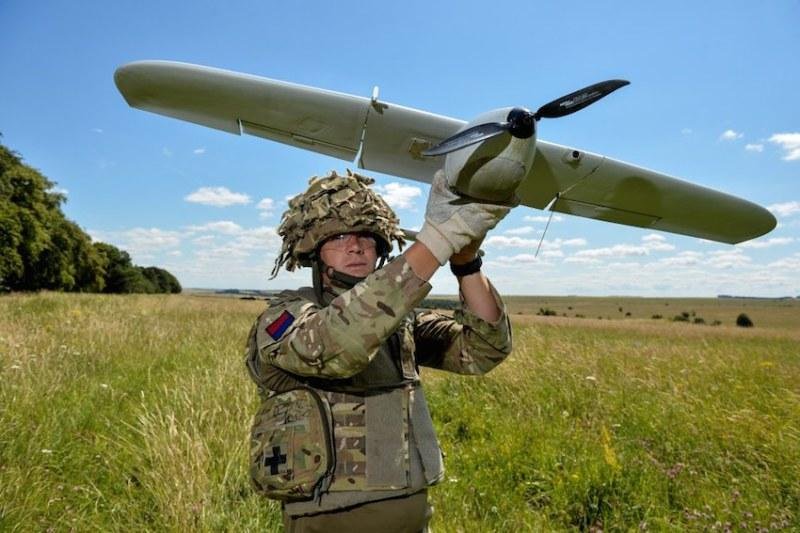
Drones are not a flash in the pan. They have made the battlefield more transparent, more lethal, and more congested. Across the many forms they take, they now perform intelligence, surveillance, target acquisition, reconnaissance and strike tasks that crewed platforms once monopolised — and frequently do them better, cheaper, and without risking a human crew. Drones have democratised air power, allowing a smaller force to overmatch a larger one. They have redefined no man’s land, the contested strip between the forward line of own troops and that of the enemy. In previous wars this was 500–1,000 m deep; today it is a 30–40 km corridor running the length of the front. Anything that moves inside it is seen and targeted. Ukraine has embedded uncrewed air systems across the entire force: small drones fight the close battle; specialised units operate long-range strike drones to win the deep battle. Networked and persistent, drones have forced a fundamental rethink of established doctrine and tactics.
But the single most important insight is that Ukraine is a data point, not a template. It is the hardest case, not the general one — two under-resourced, casualty-averse armies grinding across defences cultivated over three years, where drones have stripped both sides of the ability to manoeuvre and produced an attritional stalemate fairly described as “World War One with drones.” We must learn the right lessons, not all of them. A fast-moving European conflict elsewhere would more likely be fought across hastily prepared defences with none of that depth. And because technology is evolving at lightning pace, committing to a narrow band of drone types is a guarantee of obsolescence. Categories are already collapsing as miniaturisation lets small drones do what larger ones did at a fraction of the cost — the 100 kilometre-range, two-hour-endurance class is emerging as a particular sweet spot. But we should design for the trend, not the snapshot.
This is where the DIP’s framing goes wrong. Its Land chapter promises an Army “ten times more lethal” through “autonomous systems, long range missiles, AI, and armoured vehicles” — the right words in the right order. But the money and the emphasis tell a different story. The plan treats autonomy as the headline and mass as the residual: the Land Lethality Pipeline, the one-way effectors, the drone projects (NYX £220 million, CORVUS £310 million of new money, UGVs £150 million) are presented as the transformation, while the survivable core — armour, artillery, air defence — is either continuation funding for programmes already in trouble (Ajax, Challenger 3) or conspicuously thin (Boxer, Land Mobility Programme). The plan has mistaken augmentation for combat power. That is the fallacy, and everything downstream inherits it.
What Drones Do Not Change
Resist the cult of the drone. The figure that Ukrainian drone strikes account for around 80% of Russian casualties is real, but reflects the volume of available fires — Ukraine’s chronic shortage of 155 mm — far more than the superiority of drones per engagement. Drones and artillery are complementary, not substitutes. Tubes and rockets deliver the mass, suppression and certainty that quadcopters cannot, and they do it in all weathers and despite jamming. Deep-strike tactical ballistic and cruise missiles neutralise headquarters, logistics hubs and rear-area concentrations. They reach far into the enemy’s operational depth in a way no first-person-view drone ever will. Artillery mass still matters — and the DIP’s treatment of it, folding “Close Support Artillery” and “Long Range Rocket Artillery” into modest continuation lines while lavishing narrative on drones, is exactly the inversion Ukraine warns against. The casualty statistics are a warning against letting our howitzer fleet shrink, not an argument for depletion.
Nor do drones abolish the need to physically hold ground. This is the immutable point. Land warfare remains a human contest for territory: drones are a tool that serves this objective; they cannot seize ground and cannot occupy it, they can only deny it. The 30–40 km corridor is the proof — held by neither side, denied to both. That distinction matters: the modern front is becoming a contest of denial between two thin lines of occupation, and recognising it is what makes the deep-battle, recce-strike construct so powerful. But it is human soldiers who take and hold ground, and no amount of autonomy changes that. A plan that funds denial and starves occupation has understood only half of today’s battlefield.
Finally, drones make layered air defence not a luxury but a precondition for survival. We will not regain freedom of movement inside the transparent corridor until we invest in air defence on a scale unimaginable before 2022. Note the decisive technical turn that is rarely mentioned: fibre-optic and inertial-navigation drones cannot be jammed, which is collapsing the electronic-warfare-first model and forcing everyone back towards kinetic solutions. This makes the strongest possible case for cannon and interceptor drones — and it is the area where the DIP is most negligent. A single “Ground Based Air Defence” line at £1.5 billion, and a promise to “double” Sky Sabre from a laughably small base, is not a serious answer to the pervasive aerial threat the same document spends pages describing.
How We Will Actually Fight
No one at RUSI set out how the Army needs to fight, and the DIP does not attempt it either — it is a shopping list without a scheme of manoeuvre. This must be defined, because how you fight determines what you buy when capabilities compete for a shrinking budget.
There are two battles, and the cleaner way to understand them is not deep versus close but defence versus offence. The first battle is the defensive battle — fought forward by an expeditionary force deployed fast enough to deny ground before it is lost. It has a deep element: the recce-strike contest that degrades the enemy at stand-off distance; and a close element: the prepared defence that breaks the assault when the enemy closes. The second battle is the offensive battle — the assault to retake ground already lost: closing with and physically dispossessing the enemy. The second battle is always costlier than the first — traditionally an attacker needed a three-to-one advantage to prevail — so we should always elect to fight the first battle. The best deterrent is therefore a credible expeditionary force an adversary does not doubt: deterrence by denial — you cannot take my ground without incurring significant human and materiel cost — is both cheaper and more convincing than deterrence by the promise to retake it. But the enemy gets a vote. When threat converts to aggression, ground will inevitably be lost, especially when an adversary uses the element of surprise. So you must be able to fight the second battle even though you would never choose to. This is the logic for the British Army’s two divisions with distinct roles: 1st (UK) Division as a medium wheeled expeditionary force built around Boxer and Land Mobility Programme platforms to fight the first battle, and 3rd (UK) Division as the heavy tracked manoeuvre force held to fight the second with main battle tanks and infantry fighting vehicles. This is the Army’s own future force design — a corps of two deployable divisions delivering seven combat brigades, two artillery brigades and corps enablers, on a Regular headcount restored from roughly 73,000 to 76,000. It is the minimum credible contribution to NATO, not an expression of ambition; at the height of the Cold War Britain fielded three armoured divisions, an infantry division, an artillery division and four independent brigades, and today’s Army struggles to deploy one. The DIP neither contradicts the future design nor resources it properly.
Expeditionary brigades should be prioritised first. Assume two infantry battalions per brigade, each carrying an organic drone capability down to section level. Boxer and other wheeled armoured platforms are used exactly as intended — not as combat vehicles that enter the direct-fire zone, but as battlefield taxis that deliver dismounted effect wherever it is needed. Mechanised infantry deploy to an allocated area, dig in with engineer support, and fight the deep battle with loitering munitions and by directing artillery fire. When the enemy closes, infantry reverts to FPV drones, hand-held anti-tank guided weapons and small arms. This requires platoon vehicles to carry stocks of FPV drones and loitering munitions as well as acting as a mothership for dismounted infantry. Mechanised cavalry perform a complementary role. Using a turreted Boxer, they provide an anti-drone screen and direct-fire support with organic dual-role 30–40 mm cannons able to engage aerial and ground targets. Cavalry vehicles must also carry drones — likely larger, reusable, longer-range loitering munitions and surveillance UAS. Such units operate forward to draw enemy formations into kill zones or to deploy their UAS across longer distances before withdrawing through prepared infantry positions, thereafter standing by as a quick reaction force to seal any penetration. Together, infantry and cavalry form a screen that denies ground while protecting the artillery. Divisional 155 mm and GMLRS-ER regiments fire into the enemy’s depth, supported by corps-level tactical ballistic and cruise missiles.
Manoeuvre brigades within 3rd (UK) Division follow the same overall structure. Two armoured infantry battalions per brigade are equipped with a tracked IFV, underlining the importance of replacing Warrior — a gap the DIP explicitly defers. This vehicle too must carry a dual-role 30–40 mm cannon for organic direct fire and air defence. Infantry are supported by two RAC regiments equipped with Challenger 3 and Ajax to provide direct firepower. In time, the MBT will act as a control node for uncrewed ground vehicles. Operating dispersed and able to mass quickly for an assault, heavy armour brigades rely on manoeuvre-support assets to breach minefields, clear obstacles and cross gaps. Interceptor drones, cope cages and anti-drone netting enhance survivability. Above all, UAS add the offensive firepower that helps suppress enemy defences. In this sense drones do not replace heavy armour; they augment it. The whole plan should be read through that sentence.
We must be honest about the hard parts, because neither the RUSI Land Warfare Conference nor the DIP was. The first is the survivability of movement: any wheeled or tracked armoured vehicle repositioning in a transparent battlespace is exactly what the FPV drone was built to kill. The truthful answer is night movement, dispersion, terrain masking, organic electronic warfare, decoys — and a frank acceptance of attrition rates we would currently find unconscionable. When infantry are dug in, their vehicles are concealed and protected but kept close, ready for a withdrawal if the position becomes untenable. Note what the laws of physics give us in return: the corridor is symmetrical. It punishes the attacker’s movement far more than the defender’s, because the defender moves less and from cover. That asymmetry of exposure is precisely why the first battle is the cheap one, why the defender holds the advantage, and why deterrence by denial works at all.
This is also where the fashionable case against armour collapses. What kills vehicles in this war is overwhelmingly proximity, not direct fire — artillery fragmentation, mines and small-warhead FPVs make up perhaps four-fifths of the threat a vehicle actually meets. Against that distribution the difference between a light vehicle and a Level IV-protected one is not incremental but categorical: the near-miss that shreds an open Jackal is a non-event for a Boxer, the grenade-dropping quadcopter that kills everyone in a light truck achieves nothing against netting, screens and an armoured hull. Protection is not a promise of invulnerability; it is a filter that determines what proportion of the threat spectrum requires the enemy to mount a deliberate, skilled, expensive attack rather than a cheap and casual one. Understood correctly, protection determines which battles a force is permitted to fight: a light force can fight only where the enemy is not, while a properly protected, netted, jammer-equipped wheeled force can fight inside the artillery and drone envelope with loss rates that are survivable by the people inside. The DIP’s drift towards cheap, light mass mistakes this entirely. It is enough to say that a force designed to close with an enemy and take ground from him travels behind at least Level IV protection or it does not arrive.
The second hard part is whether the second battle is even winnable. Decompose it into break-in and exploitation. Drone swarms can negate the overhead cover that gives a defender his multiplier — a trench protects against frontal fire, not from an FPV through the roof — so the break-in may now cost less than the classic three-to-one paradigm implies. Exploitation through denied depth is harder: the follow-on force must cross the corridor that punishes all movement, while the defender’s reserves range it the whole way. This is the modern echo of 1918 — armies could take the first trench but not exploit faster than reserves could seal the breach. Two things change the verdict in favour of contemporary drone-equipped manoeuvre forces. First, against a hastily prepared defence, the depth and registration that make Ukraine so intractable simply do not exist. Second, the interceptor drone is becoming a great equaliser — but understand which way it cuts. It is a defensive weapon, so it works for both sides: it blunts the defender’s killing swarm to buy back the survivability the assault needs, while the defender’s own interceptors blunt the attacker’s suppression in return. Its net effect is not to hand the field to the offence but to neutralise the swarm advantage on both sides and return the second battle to a contest of mass, combined arms and command — exactly the contest any serious army should want. With mature interceptors, layered air defence and classic combined arms, a competent commander can still break through, survive, exploit and defeat the enemy. Manoeuvre is not dead. Its entry fee has simply gone up.
One boundary condition, stated plainly because overclaiming is how good arguments die. The pattern this force is built for — find with drones, fix, degrade with fires, occupy with infantry — works against a hastily prepared defence, not a matured one. Against a fully developed Surovikin line, registered and layered in depth, a wheeled medium division without heavy armour and deliberate breaching is the wrong tool, and nothing here pretends otherwise. That is precisely why 3rd (UK) Division and its tracked mass exist, and why the DIP’s deferral of the IFV and its thin armour lines are not economies but gaps. The claim is narrower and more defensible than the drone enthusiasts’ and the armour nostalgists’ alike: in the fluid battles of exploitation, counter-penetration and pursuit that follow any rupture — the most likely battles of a NATO defensive war — a wheeled, digitised, fires-centric, properly protected division is not a compromise. It is the correct instrument. But it must be paired with a heavy division that can do the other job, and a plan that funds one without the other has understood neither.
The Foundation: An Open-Architecture Kill Web
Everything above is inert without the architecture to connect it. This is the foundation on which the entire force rests, and it must be laid first — because every drone we buy without a kill web to feed it is a wasted purchase, and every gun without a sensor to cue it is half a weapon.
CGS called for a “digital kill web” in 2025, and Project ASGARD is the welcome embryo — already, in Estonia, collapsing the sensor-to-shooter timeline from hours to minutes. The DIP funds it with £370m of new money, and at the strategic level the digital picture is, unusually, one of plenty: £7.5 billion over four years for the Digital Backbone and Targeting Web, and a further £17 billion pencilled in to 2035. This is the best-funded of the land force’s underlying needs, and the open architecture and data-fabric work now under way is pushing on an open door. The question at that level is architecture and delivery, not money.
The gap is one echelon down, and it is the echelon that fights. The DIP’s billions sit at the defence-wide, strategic layer — the cross-domain targeting web, the secret cloud, the backbone that connects theatres. What remains conspicuously unfunded is the land-tactical layer that must ride on it: the deployable combat network that a dispersed Boxer company and a dismounted section actually fight on when the strategic cloud is three echelons away and jammed. Morpheus was meant to replace Bowman by 2027 and will not, and that failure is a land-tactical CIS problem the DIP’s digital line does not visibly reach down to solve. A superbly funded strategic backbone with no modern tactical bearer beneath it is a kill web that stops working at exactly the point of contact where it matters most. The fix is to stop treating the tactical layer as a radio-replacement exercise and start treating it as a data-and-decisions problem: built on open standards, providing a software-defined environment, transmitting via voice and data across multiple bearers, and allowing new applications to be fielded in weeks. The work divides into five layers: a digital backbone (data fabric, combat operating system, security, open standards); platform services (identity and access management, data discovery, workflow orchestration, messaging, synchronisation, AI services); applications (battle management, command and control, ISR fusion, logistics, health and usage monitoring); bearers (SATCOM, MANET, 5G, Trinity and combat net radio, and the devices that ride them); and users across every echelon, mounted and dismounted. Built this way, the Land Domain C4 network is the glue that holds the force together — the multiplier that turns 20:40:40 from a slogan into a sledgehammer. More than connecting sensors to effectors, it improves command and control, letting formations observe, orient, decide and act faster than the enemy.
But it must be built on an assumption the DIP’s technophilia never confronts: the network will fail, repeatedly, at the worst possible moments, because the entire electronic-warfare effort of a competent enemy is bent on breaking it. This is why the answer is a web and not a chain — chains break at a single link — routing across satcom, mesh, 5G, Trinity and, when all else is jammed, high-frequency radio a 1944 signaller would recognise, with no single bearer trusted. And it is why mission command in 2030 is not a cultural preference or a nod to doctrine but a physical necessity: when the mesh collapses and a company is cut off from brigade and division at once, it fights on three things — the commander’s intent expressed in a single paragraph, fire authorities and control measures issued before the battle, and its own judgement. Every technology in the force exists to make that moment survivable. None of them replaces it. A C4I programme that does not design for its own failure is not a kill web; it is a single point of catastrophic failure with good marketing.
The Action Plan: Five Programmes for a Minimum Credible Force
Five programme areas follow from all of this. They are sequenced — foundation first, then the capabilities that ride on it — with acquisition reform running through every one. Where the DIP funds a line, I say so; where it does not, that is the gap.
1. Artillery and deep fires. Rebuild the arm the DIP treats as an afterthought. More 155 mm — self-propelled, wheeled where mobility demands it — and a wheeled GMLRS-class launcher with operational as well as tactical mobility, firing extended-range rockets out to 150 km. Above that, the deep-strike layer the DIP gestures at but does not resource for the land force: a 1,000 km tactical ballistic missile and a 500 km tactical cruise missile to neutralise headquarters, logistics and rear-area mass. Underpinning all of it, rebuilt munition stockpiles and the “always-on” industrial base to sustain them — the one area where the DIP’s energetics-factory commitment genuinely helps, and should be held to. Recognise explicitly that tube, rocket and drone systems are complementary, not competing. One honest question the Army should confront: whether 120 mm mortars, with modern precision natures, can replace the 105 mm light gun in the close support role — freeing 155 mm mass for the deep battle where it counts. The DIP’s £1 billion RCH-155 line and its Deep Precision Strike work with Germany are the right start; they are nowhere near sufficient.
2. Layered air defence. Build it in concentric, cost-matched tiers so we never expend a million-pound missile on a thousand-pound drone. The innermost layer is organic: vehicle-mounted interceptor drones and dual-role cannon — 35, 40 or 50 mm in calibre with proximity airburst natures — at unit level, defeating cheap, numerous threats out to 5,000 metres, with ICVs and IFVs carrying their own dual-role cannon so the manoeuvre force is not wholly dependent on dedicated batteries. Above that, dedicated short-range air defence — Starstreak HVM and LMM against larger drones, helicopters and cruise missiles, and a cannon system for high-volume counter-UAS, migrated off the ageing Stormer onto a modern platform. Above that, medium-range air defence with Sky Sabre, Land Ceptor and CAMM against aircraft and cruise missiles in depth, expanded severalfold from today’s derisory launcher count. The DIP’s single GBAD line and its “doubling” of a tiny Sky Sabre fleet is not credible. This is the capability whose absence renders every other investment survivable only on paper.
3. Drones — the augmenting layer, resourced honestly. UAS are a foundational layer of the modern battlefield, but a layer that augments combat power rather than constituting it. Field them across the force at every echelon, not as a specialist asset: a survivable ISTAR spine of 50-plus Class III/IV uncrewed systems — an MQ-class capability to replace Watchkeeper properly, which CORVUS begins but does not complete; beneath it, around 5,000 attritable Class II UAS for distributed ISTAR; beneath that, a strike mass of 50,000 Class I and Class II one-way and reusable strike drones, with the sovereign industrial capacity to scale production to 500,000 per annum on mobilisation. The dominant risk here is obsolescence, which means short-cycle framework contracts, portfolio diversity and regular software and payload refreshes — never a single large platform purchase. This is where the DIP’s instinct is right and its scale is wrong: the Land Lethality Pipeline (£400 million) and one-way effector lines are the seed, not the crop. And the whole layer is worthless without a viable C4I system to connect it.
4. Land Domain C4 — the glue. The open-architecture kill web described above, funded as the first priority, not the last. A robust, deployable network integrating communications across SATCOM, combat net radio, MANET, 5G and Trinity; establishing the digitised kill web by connecting every sensor to every effector; transforming command and control. Here the task is not to acquire new money — the DIP’s strategic digital backbone is well funded — but to ensure that allocated funding reaches the land-tactical layer, is competed at the application level rather than surrendered whole to a single prime, and is built on genuinely open standards so it does not become Bowman with a better interface. ASGARD is the overlay; the deployable tactical network beneath it is what the plan leaves unresolved. Without it, nothing else in this plan reaches its potential — and every pound spent on drones and fires dissipates instead of compounding.
5. Complete the survivable 20% — wheels first, then tracks. Acquire the armoured vehicles both divisions need to reach the fight and survive it; there is no point in a brilliant kill web and a deep magazine if the force cannot deploy. Sequence it honestly: 1st (UK) Division first, because wheeled platforms field faster than tracked ones and can deliver a credible NATO-oriented expeditionary capability by 2030. Resource the Boxer fleet across all anticipated variants, including a turreted version armed with a 30 mm cannon for the armoured cavalry — the platform that gives the expeditionary force its organic counter-UAS screen and direct-fire support. Add the Land Mobility Programme’s protected-mobility 4x4s and 6x6s, which the DIP costs at “over £500 million ” — a figure adequate only if the ambition is a token buy. Then the tracked second phase for 3rd (UK) Division: replace Warrior with a modern IFV — the requirement the DIP openly defers — and restore main battle tank mass to give the division genuine manoeuvre weight. Resource the manoeuvre-support assets — breaching, gap-crossing, obstacle-clearance — without which the second battle is unwinnable regardless of how good the kill web is. On Ajax, take the binary decision the DIP dodges: deliver it against a credible revised plan, or replace it with additional Challenger 3 and the new IFV — a configuration that is coherent whatever ultimately happens to the programme. Above all, resolve the heavy division’s purpose honestly: either fund 3rd (UK) Division as a true exploitation-under-denial force, or admit it is an insurance policy and resource it as such. Do not leave it a Cold War division reheated, frustrated by the unfinished business of Challenger 3, Ajax and the retiring Warrior.
Running through all five: acquisition reform. None of these programmes survives contact with the present procurement system, which slowly fields capabilities obsolete on arrival. We do not need to invent a new model — we already have one. The Urgent Operational Requirement process that served us in Afghanistan worked: fast, ring-fenced, ministerially backed. The reform is to institutionalise that wartime path in peacetime for the attritable, software-defined classes where the threat iterates monthly — and to accept the genuinely hard institutional swallow that comes with it: ring-fenced money, ministerial top cover, and an audit culture that treats planned obsolescence as success rather than waste. The DIP’s segmented acquisition model and commercial pathways nod at this; they do not yet institutionalise it. In a real war we would adopt Ukraine’s tempo overnight. The argument is to do it before the war, deliberately, without the forcing function of one.
The Bottom Line
The DIP was the moment to convert CGS’ vision into a pathway, and it flinched. It is a political document that mistakes augmentation for combat power — that funds the drone and starves the mass, that describes a pervasive aerial threat and answers it with a single air-defence line, that promises an Army ten times more lethal while deferring the IFV, thinning the artillery and leaving the C4I foundation unbuilt. The cancellation of Type 83 is the same error made visible at sea: the belief that a cheap, uncrewed flotilla can stand in for high-end mass. On land the consequence is quieter but no less serious.
The drone revolution did not abolish manoeuvre. It raised the entry fee — and the fee is paid in architecture, air defence and industrial tempo, not in any single drone. The five programmes above buy something specific and worth having. The kill web turns a collection of platforms into a system that sees and decides faster than the enemy, and makes every subsequent pound compound rather than dissipate. A restored artillery arm gives the force the mass and reach that drones cannot supply, while UAS give the guns the eyes they have always lacked. Drones embedded everywhere, with specialist regiments to concentrate them, let every unit fight the close battle and a dedicated few win the deep one. Layered air defence buys back the freedom to move that the enemy’s drones would otherwise deny — without it, the rest of the force cannot survive to fight. And completing the survivable 20% ensures the divisions can actually reach the fight and, where necessary, retake what has been lost. Reform is what lets us do all of it at the speed the threat demands.
And none of this is unaffordable. The two-division construct is deliberately calibrated to the army we can afford, not the army we might wish for: the capabilities above sit largely within the existing equipment plan, with the genuinely additional investment amounting to roughly £18–20 billion over the next several years — on the order of £2 billion extra a year — plus the support and personnel costs of a modest headcount uplift. Set against a Defence Investment Plan that finds £63.6 billion for the nuclear enterprise and £27.8 billion for air, the sum required to make the land force credible is small. What is missing is not money on that scale. It is the decision to spend it well.
The prize is an Army that can fight and win both first and second battles — deploying forward to deny ground cheaply and, when denial fails, manoeuvring to take it back. A force that makes an adversary think twice before committing an act of aggression is a credible deterrent and a valid contribution to NATO. The components exist, and now — unlike a year ago — so does a plan against which to measure them. The DIP is not that plan. This is the pathway it should have been. What remains missing is the same thing that was missing at RUSI: the decision to sequence these programmes, fund them, and start.


Good to see you back in print ND. An excellent article, well thought out, well argued and tightly written.
Its already clear that the DIP has already sunk like a lead balloon and doesn’t stand up to any meaningful analysis. The cold dead hands of the Treasury are all over it. Much of this stuff will surely be quietly forgotten about…and a new SDR will be along in another 18 months…
Sadly, it’s representative of the total intellectual dishonesty at the heart of the UK government which is apparent right across public policy.
LikeLike
Good to see you back in print ND. An excellent article, well thought out, well argued and tightly written.
Its already clear that the DIP has already sunk like a lead balloon and doesn’t stand up to any meaningful analysis. The cold dead hands of the Treasury are all over it. Much of this stuff will surely be quietly forgotten about…and a new SDR will be along in another 18 months…
Sadly, it’s representative of the total intellectual dishonesty at the heart of the UK government which is apparent right across public policy.
LikeLike