
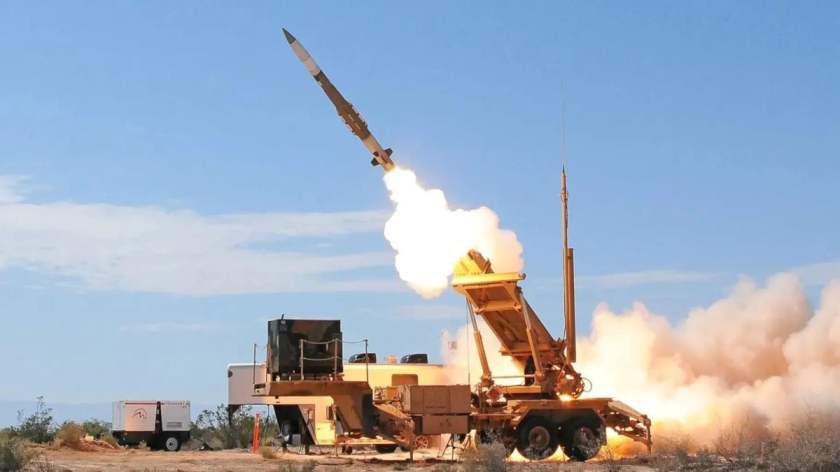
By Nicholas Drummond
A follow-up to “Britannia Shield: what it needs to be” that provides a more structured analysis of vulnerable UK bases and critical national infrastructure, and provides a detailed proposal and costs for what is needed to protect them.
The question Britannia Shield has to answer
The Britannia Shield pledge commits Britain to a national air and missile defence umbrella. It sets the ambition but not the size. The hard question — how many fire units, of what type, and at what cost — has gone unanswered. This piece answers it from first principles.
The method is deliberately simple. First, define what the shield has to protect: the fixed national target set an adversary would strike with drones, cruise missiles and tactical ballistic missiles. Second, overlay the engagement envelopes of candidate systems and solve for the minimum number of batteries needed to cover that set. Third, cost it.
A companion interactive map carries the full target set and lets every assumption be varied — coverage ambition, engagement range, which layers are shown — with the battery counts recomputing live. The numbers in this piece are drawn from it.
What the shield must defend
Britain’s fixed target set has changed surprisingly little since the Cold War. The declassified Soviet list held 106 probable targets; the modern equivalent is around 100, falling into eight categories.
| Category | Count | Examples |
|---|---|---|
| RAF / air bases | 20 | Lossiemouth, Marham, Coningsby, Lakenheath |
| Army garrison centres | 10 | Catterick, Aldershot, Tidworth–Bulford |
| Radar / ASACS stations | 10 | Fylingdales, Boulmer, Benbecula, Saxa Vord |
| Military control centres | 8 | MOD Main Building, Northwood, High Wycombe |
| Naval bases | 6 | Clyde (Faslane), Portsmouth, Devonport |
| Naval control / comms | 6 | Northwood, Forest Moor |
| Centres of government | 14 | Westminster, Edinburgh, Cardiff, GCHQ |
| Key towns & cities | 24 | London, Birmingham, Manchester, Glasgow |
| Total | 98 |
Two things have shifted since the 1980s. The USAF footprint has shrunk to two main operating bases, Lakenheath and Mildenhall. And the threat axis is no longer the overland bomber alone: one-way attack drones and submarine- or ship-launched cruise missiles can now reach the east coast and Scotland from the sea, from directions the old plan weighted lightly.
Three threats, three problems
A credible shield has to beat three different weapons, each of which stresses a different part of the defence.
- One-way attack drones (Shahed-class) — cheap, slow, low-flying, launched in mass. The problem is magazine depth and cost-per-kill, not sophistication.
- Cruise missiles — subsonic to supersonic, terrain-following, launched from ships, submarines, aircraft or the ground. The problem is sensor line-of-sight: you cannot engage what the radar cannot see over the horizon.
- Tactical and short-range ballistic missiles — steep, fast, high terminal velocity. The problem is the handful of seconds available to intercept, which demands a dedicated high-tier interceptor.
No single system answers all three. That is the whole case for layering — and the reason the question is not “which system?” but “how many of each?”
Why the answer is layered
To defend the same target set, Britain needs roughly five times as many short-range Sky Sabre batteries as long-range THAAD. Range, not numbers, is the cost driver — but because the three systems counter different threats, the counts do not substitute for one another.
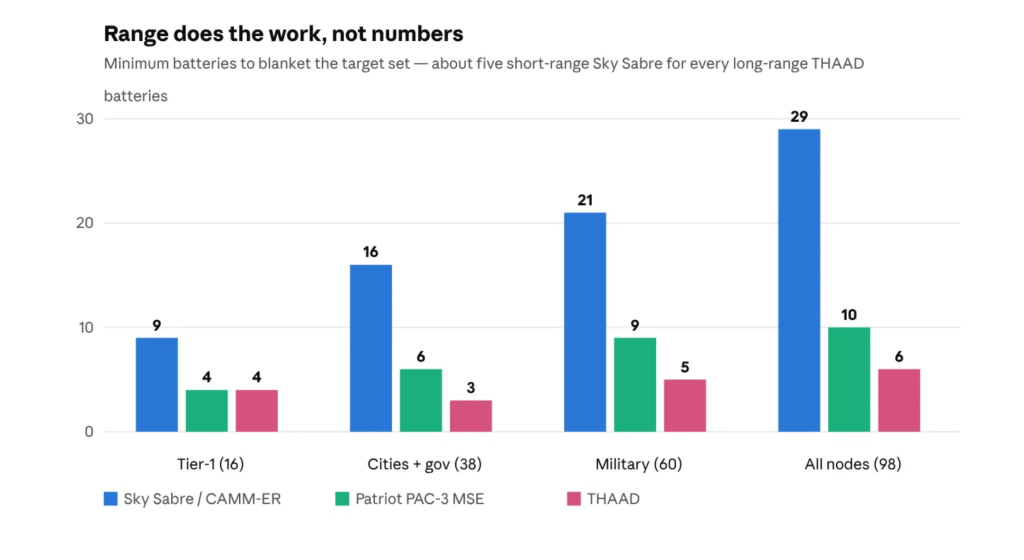
Two patterns matter. Sky Sabre’s requirement climbs steeply with ambition, because 45 km point defence cannot blanket a country. THAAD’s stays almost flat — six batteries cover the whole national set — because its count is set by geography, not by how many sites you choose to value. The conclusion writes itself: a few wide-area batteries for the ballistic problem, a medium tier for cruise, and point defence concentrated on the crown jewels.
Layer 1 — Wide-area ballistic defence (THAAD)
Six THAAD-class batteries give Britain nationwide cover against short- and medium-range ballistic missiles. The count is driven by geography rather than ambition: broadly one battery each for the south, the Midlands and north, central Scotland and the south-west, plus the far-flung outliers — the Western Isles and Shetland radar heads, and Northern Ireland — that no single mainland site can reach.
Britain operates no upper-tier BMD today. The realistic options are a THAAD foreign military sale, or a sea-based Aegis / SM-3 solution better matched to the maritime threat axis. Either is a major new capability line, not an upgrade.
The caveat matters: a 200 km ring is the interceptor’s kinematic reach, not a guaranteed footprint. The area actually defended against a given ballistic trajectory is smaller and geometry-dependent, and THAAD has little value against low, slow drones. It buys the top of the threat stack and nothing beneath it.
Layer 2 — The medium tier (Patriot PAC-3 MSE)
Ten Patriot PAC-3 MSE batteries cover the national set against cruise missiles and shorter-range ballistic threats. This is the workhorse layer, doing the bulk of the area defence between the high tier above and point defence below.
Britain operates no Patriot. This would be a second new capability line — or could be met by an equivalent such as the Franco-Italian SAMP/T. The ~120 km figure is the envelope against air-breathing targets; against ballistic threats the footprint is considerably smaller, which is precisely why the high tier is still needed above it.
Layer 3 — Point defence of critical sites (Sky Sabre / CAMM-ER)
Thirty-two Sky Sabre / CAMM-ER launch units point-defend the 16 Tier-1 sites at two per site: the deterrent at Faslane and Coulport, the carriers at Portsmouth and the fleet at Devonport, the F-35 force at Marham, the QRA bases, Fylingdales, GCHQ and the government core in London. Point defence is counted per site, not by the coverage-minimising logic of the map — a battery sitting 40 km from a crown jewel gives poor terminal defence against a sea-skimming cruise missile or a low drone, so each site needs its own organic launchers.
This is the one GBAD system Britain already fields — and it fields almost none of it. The in-service holding is a handful of batteries; the August 2025 contract adds just six more Land Ceptor launchers. Extending point defence to all 60 military sites would need roughly 120 launch units. The distance between what we hold and what the target set demands is the starkest number in this analysis.
The 32 UK point-defence launch units are augmented by 24 deployable units for the field army, 12 for overseas bases and 4 spare — 72 launch units in total. The unit of account matters: these are launchers, which group into roughly 18 batteries, each with its own Giraffe radar and command post, not 72 complete batteries. CAMM reaches 25 km and CAMM-ER around 45 km; against low cruise missiles and drones, radar line-of-sight caps the real engagement range well inside those figures unless elevated or airborne sensors are added.
Layer 4 — the counter-drone bottom (SHORAD / C-UAS)
Beneath each Sky Sabre site sits a short-range air defence and counter-UAS layer: 2 to 4 units per location by size and importance. That is around 72 units across the UK point-defence sites — but the field army needs at least as many again to replace Stormer HVM and give deployed forces a credible counter-drone capability, so the realistic total is closer to 200 units.
This is the layer the war in Ukraine has made unavoidable. CAMM is far too expensive to expend on a £20,000 Shahed; the bottom layer is guns, VSHORAD missiles such as Starstreak and LMM, and — increasingly — directed energy, whose job is cheap, close-in kills in volume. A shield that cannot do this economically will be bankrupted by drones long before it is defeated by missiles.
The force — and the bill
The recommended force, and the hardware cost to acquire it:
| Tier | System | Units | Per unit | System cost |
|---|---|---|---|---|
| Upper | THAAD-class | 6 batteries | £1.5bn | £9.0bn |
| Medium | Patriot PAC-3 MSE | 10 batteries | £0.9bn | £9.0bn |
| Point defence | Sky Sabre / CAMM-ER | 72 launch units (~18 batteries) | £280m / battery | £5.0bn |
| Close-in | SHORAD / C-UAS | ~200 units | £20m | £4.0bn |
| Hardware total | ~£27bn |
The figures are open-source and indicative (cost estimates; converted at roughly £1 = $1.27). Two points on method. The upper and medium tiers are costed in sterling at the platform price — a THAAD battery is about $1.5–2.0bn (around £1.2–1.6bn), a Patriot PAC-3 battery about $1.0–1.2bn (around £0.8–0.95bn); an all-in foreign military sale with UK integration and infrastructure would run 20–30% higher. And the point-defence line costs launchers grouped into batteries, not 72 separate batteries: 72 launchers at roughly four per battery is about 18 batteries at £280m each.
Three things this ~£27bn does not include, each of them large. First, interceptor magazines — the missiles themselves — which for a credible war stock add £8–15bn: THAAD rounds are $12–15m each, PAC-3 MSE about $4–5m, and a 72-launcher CAMM force wants a stock in the low thousands. Second, radars, command-and-control integration, through-life support and crews. Third, resilience — these are planning counts with no overlap, no reload positions and no attrition reserve, and a laydown that could actually fight needs 1.5 to 2 times the numbers.
Put those together and the realistic programme is not £27bn but somewhere in the £45–60bn range, spread across a decade. That would rival the nuclear deterrent in scale and ambition — which is the point: a national shield is an enterprise on that order, not a budget line.
The number is large, but it is knowable
Britannia Shield is not a budget line. It is a multi-billion-pound, decade-long national endeavour on the scale of the nuclear deterrent. But the number is finite and knowable: six upper-tier and ten medium-tier batteries, 72 Sky Sabre launch units and around 200 SHORAD vehicles — roughly £27bn of hardware, and £45–60bn as a programme done properly.
If the money has to be phased — and it will — the priority order falls out of the analysis. Buy the upper tier and the Tier-1 point and SHORAD layers first: they protect the deterrent, the carriers and the machinery of government, and they cannot be improvised once a crisis has begun. The medium tier can follow. One caveat on sequencing: the 32-unit homeland point-defence figure assumes Patriot and THAAD exist to carry the area layer; until they do, Sky Sabre is the only GBAD we have, so the interim buy should be larger, drawn down as the upper tiers arrive.
The alternative is to keep pretending that a handful of Sky Sabre batteries amounts to a national shield. The target set is 98 points. We currently defend almost none of them. That, far more than the price tag, is the number that should concentrate minds.


Excellent analysis. What about sites like Barrow in Furness?
LikeLike